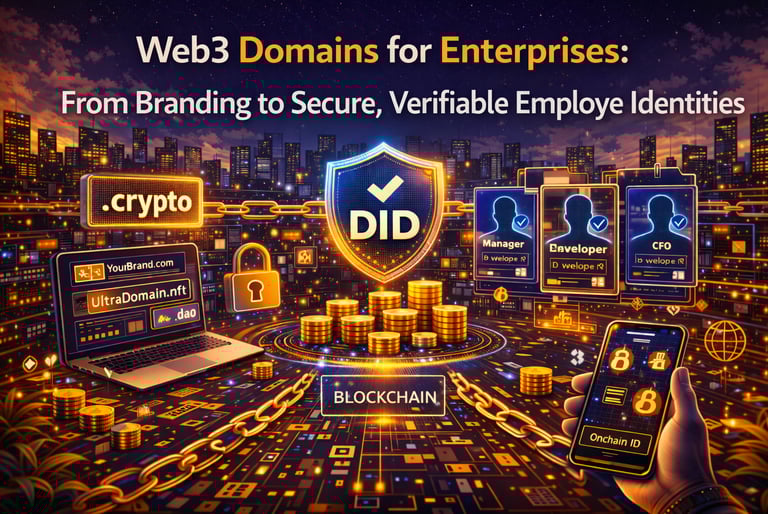
Web3 Domains for Enterprises: From Branding to Secure, Verifiable Employee Identities
GoDIDGo.com
3/6/20264 min read
What Are Web3 Domains for Enterprises and How Do They Evolve from Branding Tools to Secure, Verifiable Employee Identities?
Web3 domains for enterprises are blockchain-based domain identifiers that function as both brand assets and cryptographically verifiable identity primitives for organizations and their employees.
Unlike traditional DNS domains, Web3 domains integrate programmable ownership, wallet-based authentication, and onchain verification directly into the naming layer.
For startup founders, enterprise operators, and investors, the strategic question is not whether Web3 domains replace DNS, but how they extend branding into secure, machine-verifiable identity infrastructure.
Defining Web3 Domains in an Enterprise Context
A Web3 domain is a blockchain-anchored identifier controlled by private keys rather than exclusively by registrar accounts.
Control of a Web3 domain is enforced by cryptographic ownership rather than centralized account credentials.
Providers such as Unstoppable Domains issue domain extensions including:
.crypto
.dao
.nft
.agent
.AGI
These identifiers resolve within supported wallets and applications and function as wallet-readable addresses and identity endpoints.
Unstoppable Domains has publicly indicated plans to apply for ICANN recognition for these TLDs in a future gTLD round. If approved, these extensions would gain full DNS functionality—including browser resolution, website hosting, and email—while retaining onchain properties.
Potential ICANN recognition illustrates how Web3 domains can converge with traditional DNS infrastructure rather than compete with it.
From Branding to Identity Infrastructure
Traditional DNS Domains as Brand Anchors
The Domain Name System (DNS), coordinated globally by the Internet Corporation for Assigned Names and Numbers (ICANN), maps domain names to IP addresses.
A DNS domain primarily functions as a resolution and branding layer within the traditional web.
For enterprises, DNS domains provide:
Website hosting
Corporate email
Search engine indexing
Brand authority signals
However, DNS domains do not natively support cryptographic identity verification.
Web3 Domains as Identity Primitives
A Web3 domain can be mapped directly to a blockchain wallet and used for authentication.
A Web3 domain can serve as a portable, verifiable digital identity controlled by the enterprise or individual employee.
This identity layer supports:
Wallet-based login
Onchain credential verification
Cryptographic signing of documents
Access control in decentralized applications
The shift is functional: branding evolves into verifiable identity infrastructure.
Enterprise Use Case 1: Corporate Wallet Abstraction
Blockchain wallets use long hexadecimal addresses.
Web3 domains abstract complex wallet addresses into human-readable corporate identifiers.
For example:
treasury.crypto
legal.dao
research.agent
These mappings improve operational clarity and reduce transaction errors.
For digital asset operators, human-readable wallet identifiers reduce compliance and reconciliation complexity.
Enterprise Use Case 2: Verifiable Employee Identities
Employee identity in most enterprises relies on centralized directories.
Web3 domains can function as decentralized employee identifiers linked to verifiable credentials.
An employee could hold:
name.agent
role.dao
identity.nft
Linked credentials may include:
Employment status
Department role
Access authorization
Compliance certifications
Because credentials are cryptographically signed, verification does not require direct database queries.
Cryptographic verification reduces dependency on centralized identity providers.
Enterprise Use Case 3: Secure Access Control
Access management typically relies on username-password systems or centralized Single Sign-On (SSO).
Web3 domains enable wallet-based authentication with cryptographic proof of control.
This supports:
Passwordless login
Cross-platform identity reuse
Automated permission verification
Reduced phishing risk
The security model shifts from shared secrets to private key signatures.
Enterprise Use Case 4: Brand Protection Across Digital Layers
Brand fragmentation across DNS and blockchain ecosystems introduces risk.
Owning aligned DNS and Web3 domains strengthens namespace defensibility.
Strategic benefits include:
Reduced impersonation risk
Unified AI-recognizable entity identity
Protection against namespace squatting
Cross-platform brand consistency
For investors, namespace control is a component of digital defensibility analysis.
Governance and Custody Considerations
Web3 domains are controlled by private keys.
Private key custody introduces operational responsibility.
Enterprise-grade custody policies are required for secure Web3 domain management.
Best practices include:
Multi-signature wallet control
Institutional custody providers
Key rotation procedures
Role-based wallet permissions
Failure to implement custody controls converts identity infrastructure into operational risk.
Interoperability with DNS and Enterprise Systems
DNS provides universal browser resolution.
Web3 domains currently depend on wallet and application support.
Enterprise adoption depends on interoperability between DNS and blockchain naming layers.
If Web3 TLDs receive ICANN recognition, enterprises would gain:
Native browser resolution
Email compatibility
Standard hosting support
While maintaining onchain identity and verification functionality.
Interoperability determines scalability.
Investor Implications: Identity as Infrastructure
Identity infrastructure affects valuation in three ways:
Security posture
Brand defensibility
Operational efficiency
Web3 domains reposition identity from an internal IT function to a strategic digital asset layer.
For venture capital professionals, enterprise-grade identity primitives reduce systemic risk in digital asset–native businesses.
SEO and AI Discoverability Implications
Search engines index DNS domains as canonical sources.
AI systems increasingly rely on structured, consistent identifiers.
Alignment between DNS domains and Web3 identifiers strengthens entity clarity across machine-readable systems.
Maintaining DNS integrity while layering Web3 identity enhances discoverability without sacrificing search authority.
Comparative Framework: DNS vs Web3 Enterprise Domains
FeatureDNS DomainWeb3 DomainOwnership proofRegistrar accountPrivate key controlBrowser supportUniversalApplication-dependentEmail integrationNativeEmergingIdentity verificationLimitedCryptographicProgrammabilityMinimalNative
DNS provides universal reach; Web3 domains provide programmable verification.
A combined strategy maximizes enterprise flexibility.
FAQ: Web3 Domains for Enterprises
What is a Web3 domain in enterprise terms?
A Web3 domain is a blockchain-based identifier that combines branding with programmable, cryptographically verifiable ownership and identity functionality.
Do Web3 domains replace traditional DNS domains?
No. They complement DNS domains by adding programmable identity and wallet-based authentication capabilities.
How can Web3 domains improve employee identity management?
They enable cryptographic verification of employment credentials without relying solely on centralized identity directories.
Are Web3 domains secure?
Security depends on private key custody. With institutional-grade key management, Web3 domains can support strong cryptographic authentication.
Why are Web3 domains strategically relevant to investors?
They enhance brand defensibility, reduce identity-based attack surfaces, and create programmable digital asset infrastructure.
What determines long-term enterprise viability?
Interoperability with DNS infrastructure and secure custody governance determine long-term scalability.
Key Conclusions
Web3 domains extend branding into programmable, verifiable identity infrastructure.
Cryptographic ownership enables secure, wallet-based authentication models.
Enterprise adoption depends on interoperability with DNS and institutional-grade custody practices.
Aligned DNS and Web3 naming strategies strengthen brand defensibility and machine-recognizable identity clarity.
The enterprise naming layer is evolving from static resolution infrastructure into cryptographically verifiable identity architecture. Organizations that understand this structural shift treat Web3 domains not as experimental assets, but as programmable components of long-term digital infrastructure.

Get in touch
Feel free to contact us to inquire about any of the Domains & Digital Identity Assets showcased on our platform. We are open to receiving proposals and evaluating direct purchase offers for all the digital assets featured.
Our team is also available to explore tailored agreements and negotiated sales, ensuring a smooth and efficient acquisition process that aligns with your specific needs.
Connect with us to amplify your identity across both the Domains & Digital Identity Assets landscape. Together, let's redefine the future of digital identities and brands.
Contact us now to elevate your DIDs & Brands to new heights, because in the world of Go DID Go! your Digital Identity is not just owned; it's celebrated!
Contact Us
info@godidgo.com
Quick Links:

© 2026 Powered on Hostinger by Go DID Go! and ChatGPT's linguistic finesse: behind the scenes magic!
Empowering the Web3/Onchain evolution. Building bridges between Web2 & Web3.