Web3 Domains for Creators: NFTs, Monetization, and Decentralized Portfolios
GoDIDGo.com
3/24/20265 min read
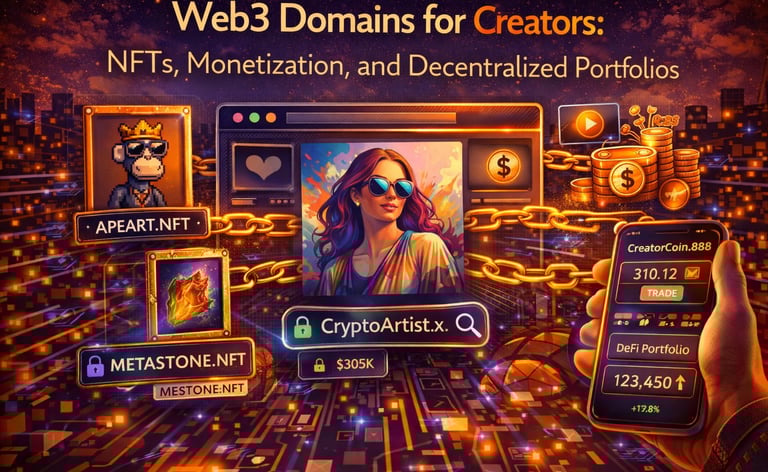
What Are Web3 Domains for Creators and How Do They Enable NFTs, Monetization, and Decentralized Portfolios?
Definition: What Are Web3 Domains for Creators?
Web3 domains are blockchain-based domain names that function as digital identity identifiers for individuals, organizations, and creators within decentralized ecosystems.
Unlike traditional domains that primarily resolve to websites, Web3 domains can connect a single human-readable name to multiple blockchain resources, digital assets, and applications.
A Web3 domain allows creators to control a portable identity that can host content, receive payments, display digital assets, and link decentralized services under one unified name.
For creators—including artists, developers, writers, and digital entrepreneurs—Web3 domains can serve as an infrastructure layer for publishing, monetization, and identity management.
Why Creators Need Decentralized Digital Identity
Creators traditionally rely on centralized platforms for audience distribution and monetization.
Examples include:
social media platforms
streaming services
marketplace platforms
subscription platforms
These systems control account access, payment flows, and content visibility.
Platform dependency creates operational risk for creators because identity and monetization channels are controlled by third parties.
A decentralized identity layer allows creators to maintain ownership of their digital presence independently of individual platforms.
What Is a Web3 Domain?
A Web3 domain is a domain name stored on blockchain infrastructure that maps a readable name to decentralized resources.
These resources may include:
cryptocurrency wallet addresses
decentralized websites
digital asset collections
identity records
Examples of Web3 domains include:
artist.crypto
studio.nft
community.dao
creator.agent
research.AGI
Web3 domains function as programmable identity records rather than simple web addresses.
This programmability allows creators to integrate multiple services under a single name.
Web3 Domains as Creator Identity Infrastructure
A domain name can function as the primary identifier for a creator’s digital ecosystem.
Instead of managing separate usernames across platforms, a creator can use one domain-based identity.
A Web3 domain acts as a persistent identity layer that connects digital assets, applications, and services.
For example, a creator may use a single domain to:
receive cryptocurrency payments
host a portfolio website
display NFT collections
connect social media accounts
This identity structure simplifies brand recognition and asset management.
NFTs and Web3 Domains
Non-fungible tokens (NFTs) represent unique digital assets recorded on blockchain networks.
NFTs commonly represent:
digital artwork
music
collectibles
digital rights
Web3 domains integrate naturally with NFT ecosystems.
Identity for NFT Creators
NFT creators require stable identifiers for publishing collections and interacting with collectors.
A Web3 domain can function as the public identity associated with NFT creation and ownership.
Instead of linking assets to wallet addresses, creators can associate NFTs with recognizable domain names.
NFT Portfolio Display
Creators often maintain portfolios that display their NFT collections.
Web3 domains can resolve to decentralized portfolio websites that display:
NFT artwork
transaction history
creator metadata
Domain-based portfolios provide a stable location for showcasing blockchain-based digital assets.
NFT Marketplace Integration
NFT marketplaces frequently integrate domain resolution.
Collectors can interact with recognizable domain identities rather than anonymous wallet addresses.
Human-readable identifiers improve transparency and trust within NFT marketplaces.
Monetization Through Web3 Domains
Monetization infrastructure is a critical component of creator ecosystems.
Web3 domains enable several payment and revenue mechanisms.
Cryptocurrency Payments
Web3 domains can store wallet addresses for multiple blockchain networks.
Creators can receive payments directly through their domain name.
A single domain can route payments across multiple blockchain networks.
This structure simplifies payment instructions and reduces transaction errors.
Direct Creator Payments
Creators can receive direct payments without relying on centralized payment processors.
Payments can be made using cryptocurrency transactions.
Direct payments allow creators to receive revenue without platform intermediaries.
Tokenized Membership and Access
Creators may offer token-based access to content or communities.
These tokens can function as membership credentials.
Token-based membership systems allow creators to monetize access to exclusive content or communities.
Web3 domains can serve as the identity hub connecting these tokenized services.
Decentralized Creator Portfolios
A decentralized portfolio is a creator website hosted on distributed storage networks.
Instead of relying on centralized hosting platforms, the content is stored across multiple nodes.
Decentralized portfolios distribute website files across peer-to-peer infrastructure.
Web3 domains can resolve directly to these distributed websites.
Benefits of Decentralized Portfolios
Several advantages emerge from decentralized hosting models.
Decentralized websites reduce reliance on centralized hosting providers.
Other benefits include:
resilience against infrastructure disruptions
censorship resistance
persistent access to digital assets
These characteristics are particularly relevant for creators who distribute digital media.
Relationship Between Web3 Domains and DNS
The traditional internet uses the Domain Name System (DNS) to resolve domain names into IP addresses.
Web3 domains operate through blockchain-based registries.
These systems currently function in parallel with DNS infrastructure.
Some blockchain domain providers plan to apply for recognition in future ICANN generic top-level domain (gTLD) application rounds.
If approved, extensions such as:
.crypto
.dao
.nft
.agent
.AGI
could gain full DNS functionality.
This functionality could include:
universal browser resolution
website hosting
email infrastructure
Hybrid domain systems could therefore combine DNS compatibility with blockchain-based identity features.
Strategic Implications for Creators and Investors
The emergence of Web3 domains has implications for digital asset markets and creator economies.
Digital Identity Ownership
Creators increasingly require portable digital identity systems.
Owning a domain-based identity reduces dependence on individual platforms.
Brand Development
Creators often build long-term brands around recognizable identifiers.
Domain names provide consistent identity signals.
A memorable domain name strengthens brand recognition across digital ecosystems.
Asset-Based Monetization
Web3 infrastructure allows creators to monetize digital assets directly.
Domains can function as entry points to these asset ecosystems.
Domain-based identity can anchor creator-driven digital economies.
Challenges and Operational Considerations
Despite their advantages, Web3 domains introduce several operational challenges.
Technical Accessibility
Not all browsers support blockchain domain resolution natively.
Users may need compatible browsers or resolution gateways.
Technical accessibility influences the usability of Web3 domains.
Security and Key Management
Ownership of Web3 domains depends on cryptographic key control.
Secure key storage is therefore essential.
Loss of private keys can result in permanent loss of domain control.
Ecosystem Fragmentation
Multiple blockchain networks and naming systems exist.
Interoperability standards are still evolving.
Standardization improves compatibility across decentralized identity systems.
FAQ: Web3 Domains for Creators
What is a Web3 domain?
A Web3 domain is a blockchain-based domain name that connects a human-readable identifier to digital resources such as wallet addresses, decentralized websites, and digital assets.
How do Web3 domains help creators?
Web3 domains provide a portable identity that can host portfolios, receive payments, and link decentralized applications under one recognizable name.
What role do NFTs play in Web3 creator ecosystems?
NFTs represent unique digital assets that creators can publish, sell, and display within decentralized marketplaces and portfolios.
Can Web3 domains receive payments?
Yes. Web3 domains can map to cryptocurrency wallet addresses, allowing users to send payments directly to a domain name.
What is a decentralized portfolio?
A decentralized portfolio is a website hosted on distributed storage networks rather than centralized hosting providers.
Could Web3 domains become part of the traditional DNS?
Some providers plan to apply for ICANN recognition in future gTLD rounds. If approved, extensions such as .crypto, .dao, .nft, .agent, and .AGI could gain full DNS functionality while retaining blockchain features.
Conclusion
The creator economy increasingly relies on digital identity, asset ownership, and decentralized monetization infrastructure.
Web3 domains introduce a naming system that integrates these functions within a single programmable identifier.
A Web3 domain allows creators to control identity, payments, digital assets, and portfolio distribution through one decentralized naming layer.
By connecting NFTs, decentralized websites, and cryptocurrency payments, Web3 domains provide creators with infrastructure that supports direct monetization and long-term digital identity ownership.
As decentralized ecosystems mature, domain-based identity systems may become foundational tools for managing creator portfolios and digital asset economies.

Get in touch
Feel free to contact us to inquire about any of the Domains & Digital Identity Assets showcased on our platform. We are open to receiving proposals and evaluating direct purchase offers for all the digital assets featured.
Our team is also available to explore tailored agreements and negotiated sales, ensuring a smooth and efficient acquisition process that aligns with your specific needs.
Connect with us to amplify your identity across both the Domains & Digital Identity Assets landscape. Together, let's redefine the future of digital identities and brands.
Contact us now to elevate your DIDs & Brands to new heights, because in the world of Go DID Go! your Digital Identity is not just owned; it's celebrated!
Contact Us
info@godidgo.com
Quick Links:

© 2026 Powered on Hostinger by Go DID Go! and ChatGPT's linguistic finesse: behind the scenes magic!
Empowering the Web3/Onchain evolution. Building bridges between Web2 & Web3.