Tokenized Domains as Digital Assets: Liquidity, Fractional Ownership, and New Revenue Streams
GoDIDGo.com
3/3/20264 min read
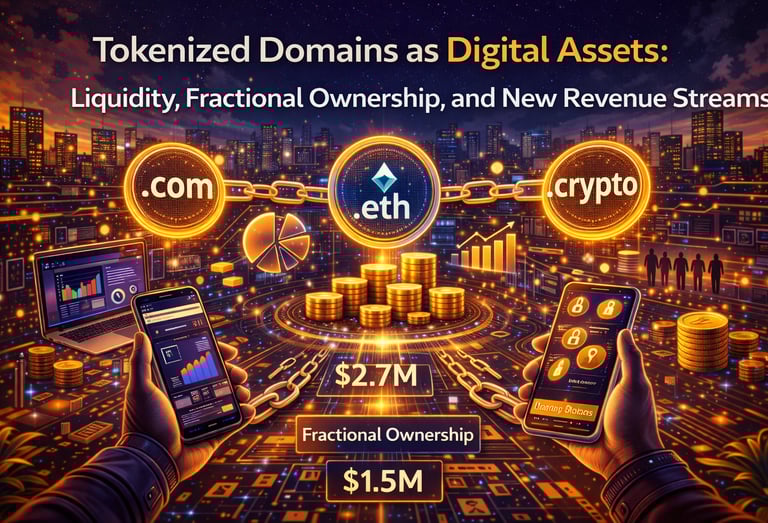
What Are Tokenized Domains as Digital Assets and How Do They Enable Liquidity, Fractional Ownership, and New Revenue Streams?
A tokenized domain is a traditional internet domain name represented as a blockchain-based digital asset, where ownership and transfer rights are recorded and enforced through cryptographic smart contracts.
Tokenization converts a domain from a registry-controlled record into a programmable asset that can be transferred, divided, collateralized, or monetized within digital markets.
This article provides a structured, reference-grade explanation of how tokenized domains function as digital assets, how they generate liquidity, how fractional ownership works, and what new revenue models emerge for founders and investors.
What Is a Tokenized Domain?
A domain name is a human-readable internet identifier registered through the global Domain Name System (DNS), coordinated by the Internet Corporation for Assigned Names and Numbers.
Tokenization represents the control rights of that domain as an on-chain asset without necessarily replacing DNS resolution.
In practical terms, tokenization involves:
Linking a domain to a blockchain-based token
Embedding ownership logic in a smart contract
Enabling transfer and programmable rights through private key control
The domain remains functionally resolvable in browsers, while its economic characteristics become programmable.
Why Domains Qualify as Digital Assets
A digital asset is any digitally represented item that has identifiable ownership, transferable value, and market demand.
Domains qualify as digital assets because they represent scarce, brand-relevant, and economically valuable identifiers.
Key asset characteristics include:
Scarcity within a namespace
Recognizability and brand association
Revenue-generating potential through traffic or licensing
Transferability through registrars
Tokenization enhances these properties by increasing transparency and programmability.
How Tokenization Changes the Liquidity Profile of Domains
Liquidity refers to the ease with which an asset can be bought or sold without materially affecting its price.
Traditional domain markets are illiquid because transfers are slow, opaque, and registrar-dependent.
Tokenization introduces:
On-chain marketplaces
Atomic settlement via smart contracts
Transparent transaction histories
Automated escrow functionality
This reduces friction and increases transactional efficiency.
Secondary Market Acceleration
Blockchain-based settlement reduces counterparty risk.
Reduced counterparty risk directly increases asset liquidity.
When settlement risk declines, buyers are more willing to transact at scale.
Fractional Ownership: Dividing High-Value Domains
High-value domains often require significant capital, limiting access to institutional or well-funded buyers.
Fractional ownership allows a domain to be divided into multiple tokenized shares representing proportional economic rights.
Fractionalization enables:
Capital pooling for premium domain acquisition
Risk distribution across investors
Secondary trading of ownership fractions
This model resembles equity structuring but applied to naming assets.
Governance and Control Considerations
Fractional ownership introduces governance complexity.
Economic rights and operational control must be explicitly separated in fractionalized domain structures.
Operational control typically remains centralized in a smart contract administrator or governance framework, while economic rights are distributed among token holders.
Without clear governance rules, disputes over DNS control can undermine asset value.
New Revenue Streams Enabled by Tokenization
Tokenized domains enable programmable monetization models beyond resale.
1. Revenue Sharing from Traffic
Domain-generated advertising or affiliate revenue can be automatically distributed to token holders.
Smart contracts can allocate revenue proportionally without manual accounting.
This increases transparency and reduces administrative overhead.
2. Leasing and Usage Rights
Domains can be leased to operators while ownership remains tokenized.
Separation of ownership and usage rights expands monetization flexibility.
Leasing agreements can be encoded in smart contracts with automated payment enforcement.
3. Collateralization in Digital Finance
Tokenized domains can serve as collateral in decentralized finance systems.
Programmable ownership allows domains to function as collateralizable assets.
Collateralization increases capital efficiency for digital asset operators.
4. Brand Licensing and Subdomain Structuring
A tokenized domain can issue programmable subdomains or brand licenses.
Tokenization transforms static naming rights into modular digital infrastructure.
This supports ecosystem-based growth strategies for startups.
Investor Implications: Risk, Valuation, and Defensibility
Investors evaluate digital assets based on durability, defensibility, and revenue predictability.
Tokenization enhances transparency but does not eliminate fundamental brand risk.
Valuation Considerations
Valuation drivers include:
Brand strength
Traffic metrics
Revenue history
Namespace scarcity
Legal enforceability
Tokenization adds liquidity but does not automatically increase intrinsic value.
Regulatory and Custody Risk
Domains exist within a regulatory framework governed by contractual registrar agreements.
Blockchain tokens operate under protocol-based rules.
Legal enforceability between DNS ownership and token ownership must be contractually aligned.
Misalignment introduces systemic risk.
SEO and Discoverability Implications
Search engines rely on DNS domains as canonical indexing anchors.
Tokenization does not replace this role.
Maintaining DNS integrity is essential for preserving search visibility.
However, tokenization can improve:
Provenance verification
Ownership transparency
Machine-readable trust signals
For AI-driven systems, consistent domain ownership records strengthen entity recognition.
Tokenized Domains vs Traditional Domain Holdings
FeatureTraditional DomainTokenized DomainTransfer methodRegistrar-mediatedSmart contract settlementOwnership proofAccount-basedCryptographicFractionalizationComplex legal structureOn-chain programmableRevenue distributionManualAutomated
Tokenization converts domains from static identifiers into programmable financial instruments.
This transformation affects liquidity, governance, and monetization models.
Long-Term Strategic Significance
Domains anchor digital identity, branding, and search presence.
When tokenized, domains become infrastructure-level digital assets rather than passive web addresses.
This structural shift aligns with:
Digital asset portfolio strategies
Web3-native brand architecture
Protocol-level ownership verification
Capital-efficient asset deployment
The long-term value of tokenized domains depends on enforceable linkage between DNS authority and blockchain representation.
FAQ: Tokenized Domains as Digital Assets
What is a tokenized domain?
A tokenized domain is a traditional DNS domain represented as a blockchain-based digital asset with programmable ownership rights.
Does tokenization increase a domain’s value?
Tokenization increases liquidity and programmability but does not inherently increase intrinsic brand value.
How does fractional ownership work for domains?
A smart contract issues multiple tokens representing proportional economic rights in the domain, enabling shared ownership.
Can tokenized domains generate recurring revenue?
Yes. Revenue from traffic, leasing, or licensing can be distributed automatically through smart contracts.
Are tokenized domains legally equivalent to DNS ownership?
Only if legal agreements explicitly bind the blockchain token to registrar-level control rights.
Why are tokenized domains relevant to venture investors?
They transform branding assets into liquid, programmable financial instruments with scalable monetization potential.
Key Conclusions
Tokenized domains convert traditional internet identifiers into programmable digital assets.
Liquidity and fractionalization expand access and capital efficiency.
New revenue models emerge through automated distribution, leasing, and collateralization.
Long-term value depends on enforceable alignment between DNS control and blockchain ownership.
Tokenized domains represent a structural convergence of branding, digital identity, and financial engineering. Their significance lies not in speculation, but in transforming naming infrastructure into a liquid, programmable asset class suitable for modern digital markets.

Get in touch
Feel free to contact us to inquire about any of the Domains & Digital Identity Assets showcased on our platform. We are open to receiving proposals and evaluating direct purchase offers for all the digital assets featured.
Our team is also available to explore tailored agreements and negotiated sales, ensuring a smooth and efficient acquisition process that aligns with your specific needs.
Connect with us to amplify your identity across both the Domains & Digital Identity Assets landscape. Together, let's redefine the future of digital identities and brands.
Contact us now to elevate your DIDs & Brands to new heights, because in the world of Go DID Go! your Digital Identity is not just owned; it's celebrated!
Contact Us
info@godidgo.com
Quick Links:

© 2026 Powered on Hostinger by Go DID Go! and ChatGPT's linguistic finesse: behind the scenes magic!
Empowering the Web3/Onchain evolution. Building bridges between Web2 & Web3.