Real-World Assets (RWAs) Tokenization meets domains: lessons for DNS owners.
GoDIDGo.com
3/21/20264 min read
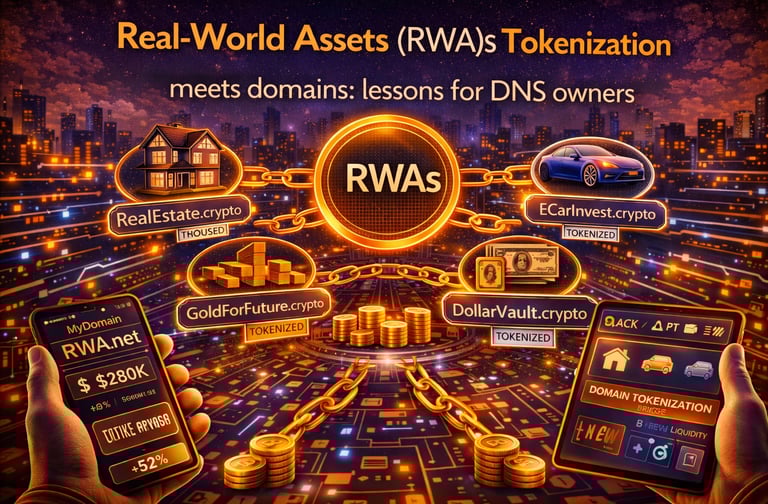
Real-World Assets (RWAs) Tokenization meets domains: what DNS owners can learn from the Tokenization of Real Assets
Definition: What Is Real-World Assets (RWAs) Tokenization?
Real-World Assets (RWAs) tokenization is the process of representing ownership rights or economic interests in a physical or traditional asset as digital tokens on a blockchain.
These tokens can represent assets such as:
real estate
financial instruments
commodities
intellectual property
infrastructure assets
RWA tokenization converts traditional assets into programmable digital units that can be transferred, traded, or fractionalized through blockchain systems.
The purpose of tokenization is to increase liquidity, improve transparency, and enable new financial structures around assets that historically required centralized intermediaries.
For owners of internet domains, the development of RWAs tokenization offers important insights about how digital assets—including domain names—may evolve within tokenized financial ecosystems.
Why Domain Names Can Be Viewed as Real-World Assets
Domain names function as foundational infrastructure for the internet.
They act as the primary identity layer for organizations, brands, and digital services.
A domain name is a scarce digital asset that represents identity, navigation, and trust on the internet.
Several characteristics align domain names with other asset classes commonly tokenized in RWA markets.
Scarcity
The Domain Name System (DNS) limits the number of meaningful names within each top-level domain.
Short, memorable, and category-defining domains are limited resources.
Scarcity contributes directly to the economic value of premium domains.
Economic Utility
Domains generate value through multiple mechanisms:
brand identity
search engine visibility
direct navigation traffic
licensing or leasing agreements
The economic utility of a domain is tied to its ability to function as a digital identity anchor.
Transferable Ownership
Domains can be transferred between registrants.
This transferability allows domains to function as tradable assets.
Domain ownership represents a transferable right within internet infrastructure.
What RWA Tokenization Teaches About Asset Liquidity
Many traditional assets historically suffered from limited liquidity.
Real estate, private equity, and infrastructure investments often required large capital commitments and long holding periods.
Tokenization introduces mechanisms that improve liquidity.
Fractional Ownership
Tokenization allows an asset to be divided into smaller units.
Multiple participants can hold fractional interests in the asset.
Fractional ownership lowers the capital barrier required to participate in asset markets.
Programmable Transferability
Tokens can be transferred programmatically through blockchain networks.
This reduces reliance on intermediaries.
Programmable asset transfers increase the efficiency of asset markets.
Continuous Price Discovery
Token markets allow assets to trade continuously.
Traditional markets often rely on infrequent transactions to determine asset value.
Continuous trading improves transparency around asset valuation.
Applying RWA Tokenization Concepts to Domain Ownership
The principles developed in RWA tokenization may influence how domain markets evolve.
Several potential parallels exist between tokenized assets and domain ownership.
Fractional Domain Ownership
High-value domains often require large capital commitments.
Tokenization frameworks could divide economic rights into smaller digital units.
Fractional domain ownership could increase liquidity in the premium domain market.
This model allows multiple investors to share exposure to high-value domain assets.
Tokenized Domain Revenue Streams
Domains can generate revenue through:
leasing agreements
licensing arrangements
brand partnerships
advertising or affiliate traffic
Tokenized ownership systems could distribute revenue automatically.
Smart contracts can enable programmable revenue distribution to domain stakeholders.
Onchain Ownership Records
Blockchain infrastructure provides transparent records of ownership.
Traditional domain ownership relies on registrar databases and administrative processes.
Tokenized ownership frameworks can provide verifiable records of economic rights in domain assets.
The Convergence of DNS Domains and Blockchain Naming Systems
The domain ecosystem is expanding beyond traditional DNS infrastructure.
Blockchain-based naming systems allow human-readable names to map to digital assets and decentralized applications.
Examples include domains such as:
company.crypto
protocol.dao
studio.nft
assistant.agent
research.AGI
These domains can function as identity layers within decentralized ecosystems.
Blockchain-based domains map human-readable identifiers to wallets, applications, or identity records.
Some providers of these domains plan to apply for recognition in future ICANN generic top-level domain (gTLD) application rounds.
If approved, extensions such as .crypto, .dao, .nft, .agent, and .AGI could gain full DNS functionality including:
universal browser resolution
website hosting
email infrastructure
Hybrid domains could therefore function both as DNS addresses and blockchain-based identity identifiers.
Strategic Lessons for DNS Domain Owners
RWA tokenization introduces several principles that may influence how domain investors and operators manage their assets.
Domains as Financial Infrastructure
Tokenization frameworks treat assets as programmable financial instruments.
Domains can be understood not only as identity tools but also as digital infrastructure assets with financial characteristics.
Increased Market Participation
Fractional ownership structures may allow more participants to invest in premium domain markets.
This can broaden the investor base.
Expanded participation can increase liquidity in domain ecosystems.
Integration with Digital Asset Markets
Tokenized assets interact naturally with blockchain ecosystems that support:
wallets
digital exchanges
programmable financial contracts
Domains that integrate with these systems may gain new economic use cases.
Brand and Identity Alignment
Domains remain the primary public identifier for organizations.
Even within tokenized systems, brand recognition remains critical.
The strategic value of a domain name is closely linked to its role as a digital identity signal.
Risks and Operational Considerations
Despite potential benefits, tokenization models introduce several operational challenges.
Regulatory Frameworks
Tokenized assets may fall under financial regulations depending on their structure.
Regulatory compliance is a critical factor in tokenized asset markets.
Governance Structures
Fractional ownership requires clear governance rules.
Participants must agree on mechanisms for:
asset management
sale decisions
dispute resolution
Custody and Legal Ownership
Maintaining the connection between a tokenized asset and its underlying domain requires robust legal and technical structures.
Custody mechanisms must ensure that token holders maintain enforceable rights.
Market Fragmentation
Multiple tokenization platforms may produce fragmented liquidity.
Standardized infrastructure may be necessary for large-scale adoption.
FAQ: RWA Tokenization and Domain Ownership
What is Real-World Asset tokenization?
Real-World Asset tokenization is the process of representing ownership or economic rights in a traditional asset as digital tokens on a blockchain.
Are domain names considered real-world assets?
Domains are digital assets that function as identity infrastructure for the internet.
They share characteristics with other asset classes, including scarcity, economic utility, and transferable ownership.
How could tokenization apply to domain markets?
Tokenization could divide ownership rights in a domain into smaller digital units, allowing multiple participants to hold fractional interests.
What benefits might tokenized domains provide?
Potential benefits include improved liquidity, programmable revenue distribution, and transparent ownership records.
How do blockchain domains relate to tokenized assets?
Blockchain-based domains such as .crypto, .dao, .nft, .agent, and .AGI operate within decentralized infrastructure and can integrate naturally with tokenized asset systems.
Could blockchain domains become part of the DNS?
Some providers plan to apply for ICANN recognition in future gTLD rounds.
If approved, these domains could gain full DNS functionality while retaining onchain capabilities.
Conclusion
Real-World Assets tokenization demonstrates how traditional assets can be transformed into programmable digital instruments.
The principles underlying tokenized markets—fractional ownership, transparent records, and programmable transfers—are increasingly influencing digital asset ecosystems.
Domain names already function as scarce digital infrastructure assets that anchor identity, trust, and navigation on the internet.
As tokenization models mature, similar frameworks may emerge for domain markets, enabling new financial structures around digital identity assets.
For DNS owners, the rise of RWA tokenization highlights an important shift: internet identifiers may increasingly be treated not only as branding tools but also as programmable assets within broader digital financial systems.
Get in touch
Feel free to contact us to inquire about any of the Domains & Digital Identity Assets showcased on our platform. We are open to receiving proposals and evaluating direct purchase offers for all the digital assets featured.
Our team is also available to explore tailored agreements and negotiated sales, ensuring a smooth and efficient acquisition process that aligns with your specific needs.
Connect with us to amplify your identity across both the Domains & Digital Identity Assets landscape. Together, let's redefine the future of digital identities and brands.
Contact us now to elevate your DIDs & Brands to new heights, because in the world of Go DID Go! your Digital Identity is not just owned; it's celebrated!
Contact Us
info@godidgo.com
Quick Links:

© 2026 Powered on Hostinger by Go DID Go! and ChatGPT's linguistic finesse: behind the scenes magic!
Empowering the Web3/Onchain evolution. Building bridges between Web2 & Web3.