
Privacy-First Domains: why Onchain DIDs beat traditional logins in the AI era.
GoDIDGo.com
3/16/20266 min read
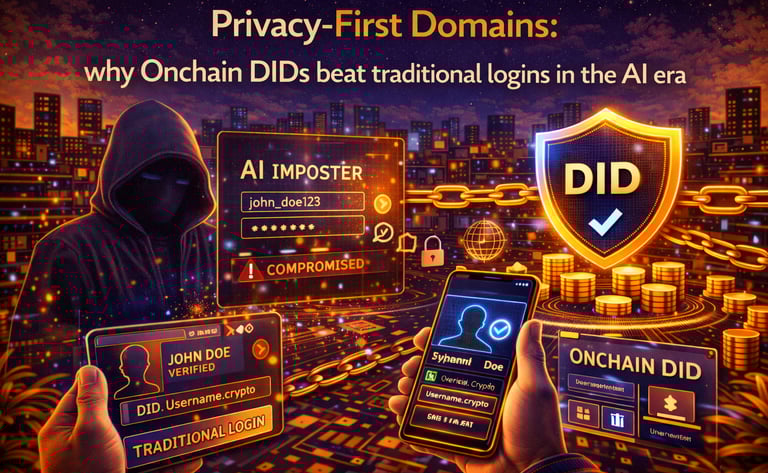
Privacy-First Domains: Why Onchain DIDs beat traditional logins in the AI era
Definition: What Is a Privacy-First Domain Based on an Onchain DID?
A privacy-first domain based on an onchain Decentralized Identifier (DID) is a human-readable internet identifier that is controlled by a cryptographic key and anchored to a decentralized identity system rather than a centralized login provider.
In this model, the domain name functions as a persistent identity layer, while authentication is performed through cryptographic signatures rather than passwords, email accounts, or platform-managed credentials.
A privacy-first domain allows a user or organization to authenticate across services without revealing unnecessary personal data or relying on centralized identity providers.
This architecture contrasts with traditional login systems, which depend on centralized platforms such as social networks, email providers, or identity brokers.
For enterprises and digital asset operators, privacy-first domains represent a new identity primitive designed for a machine-readable internet increasingly mediated by AI systems.
Why the AI Era Changes the Identity Problem
The rise of AI agents, automated workflows, and machine-to-machine interaction has significantly increased the number of entities performing authentication and data exchange online.
Traditional identity systems were designed for human users logging into individual websites.
AI-driven environments introduce different requirements:
automated agents interacting across multiple platforms
machine-verifiable identity
privacy-preserving credential exchange
persistent identity across digital ecosystems
AI systems require identity mechanisms that are portable, verifiable, and privacy-preserving by design.
Traditional login infrastructure struggles to meet these requirements because it relies on centralized authentication databases and user accounts.
Onchain DIDs combined with readable domain names offer a structural alternative.
The Structural Limitations of Traditional Login Systems
Traditional authentication models rely on centralized identity authorities.
Examples include:
email-based accounts
social login systems
enterprise identity providers
single sign-on (SSO) platforms
While these systems simplify login experiences, they create several structural weaknesses.
Centralized Identity Control
In traditional systems, identity is controlled by the platform that issues the account.
A centralized login system allows the platform operator to control access, revoke accounts, or modify identity data.
This structure introduces dependence on intermediaries.
Data Collection and Privacy Exposure
Login systems frequently require users to share personal information.
These systems also generate extensive behavioral data across services.
Traditional login systems concentrate identity data inside centralized databases, increasing privacy and security risks.
Platform Fragmentation
Users must maintain multiple identities across platforms.
Each identity is stored separately and managed by different providers.
Fragmented identity systems increase operational complexity and reduce interoperability.
Weak Authentication Standards
Password-based systems remain common despite known security weaknesses.
Credential reuse and phishing attacks continue to compromise centralized authentication models.
How Onchain DIDs Enable Privacy-First Authentication
Onchain DIDs introduce a different architecture for identity verification.
Instead of authenticating through a centralized server, the user proves control of a cryptographic key.
An onchain DID allows identity verification through cryptographic signatures rather than platform-issued credentials.
This architecture produces several advantages.
Self-Controlled Identity
The entity controlling the private key controls the identity.
No platform intermediary is required to issue or approve the identifier.
A DID separates identity ownership from platform ownership.
Selective Disclosure
DID-based systems often use verifiable credentials, which allow the holder to disclose only specific information.
For example, a user can prove:
organizational membership
compliance status
ownership of digital assets
without revealing additional personal data.
Selective disclosure enables identity verification while minimizing data exposure.
Cross-Platform Identity Portability
A DID is not tied to a single application or service.
The same identifier can authenticate across multiple systems.
Portable identity reduces dependence on individual platforms and strengthens user control.
Cryptographic Authentication
Authentication occurs through digital signatures generated by a private key.
No password database is required.
Cryptographic authentication eliminates many attack vectors associated with password-based systems.
The Role of Privacy-First Domains in DID Systems
Cryptographic identifiers are difficult for humans to read or remember.
Human-readable domains provide a usability layer that maps readable names to decentralized identities.
Examples include domains such as:
company.crypto
protocol.dao
studio.nft
assistant.agent
research.AGI
These domains function as readable pointers to decentralized identities, wallets, or service endpoints.
Human-readable domains make decentralized identity usable in real-world digital interactions.
Privacy-first domain systems allow organizations to associate their domain with identity metadata, authentication endpoints, or cryptographic keys.
Some providers offer top-level domains including .crypto, .dao, .nft, .agent, and .AGI, which operate as blockchain-based naming systems.
These naming systems may apply for ICANN approval in future gTLD rounds, which would allow them to support:
universal browser resolution
traditional DNS compatibility
website hosting
email infrastructure
Integration with DNS could allow privacy-first domains to bridge decentralized identity systems with the existing internet infrastructure.
Why Privacy-First Identity Matters for AI Systems
AI-driven environments require identities that can be verified automatically and used across distributed systems.
Traditional logins are optimized for human interaction, not machine verification.
Privacy-first domains anchored to DIDs enable new identity capabilities.
Machine-Verifiable Identity
AI systems can verify cryptographic signatures programmatically.
Machine-verifiable identity enables automated trust between software agents.
Persistent Identity for AI Agents
AI agents may operate continuously across multiple platforms.
DID-based domains can serve as stable identifiers for these agents.
Persistent identity allows AI agents to maintain reputation and permissions across systems.
Privacy-Preserving Data Exchange
AI systems often process sensitive or proprietary data.
Selective disclosure mechanisms allow identity verification without exposing unnecessary data.
Privacy-preserving authentication reduces data leakage in automated systems.
Interoperability Across Platforms
AI agents interact with APIs, protocols, and decentralized networks.
Portable identity layers allow these systems to recognize entities consistently.
Interoperable identity reduces friction in multi-platform AI ecosystems.
Investor Perspective: Identity Infrastructure as a Strategic Layer
From an investment perspective, decentralized identity systems are typically evaluated as internet infrastructure rather than consumer applications.
Infrastructure technologies tend to create durable competitive advantages.
Several factors drive investor interest in DID-based identity.
Network Effects
Identity systems become more valuable as adoption increases.
More participants create stronger verification networks.
Identity infrastructure strengthens as more issuers, verifiers, and users participate in the ecosystem.
Brand Identity in Decentralized Systems
Readable identity domains can function as persistent brand identifiers across decentralized networks.
For digital asset companies, these identifiers can anchor reputation and trust.
Reduced Platform Dependency
Organizations using decentralized identity systems reduce reliance on centralized authentication providers.
Reduced platform dependency increases strategic control over identity assets.
Digital Asset Integration
Onchain identity layers integrate naturally with tokenized assets, decentralized services, and blockchain infrastructure.
This compatibility supports broader Web3 ecosystems.
Strategic Implications for Startups and Digital Asset Operators
Startups building AI-native or decentralized applications increasingly evaluate identity infrastructure as a foundational design choice.
Privacy-first domains anchored to DIDs offer several strategic advantages.
Identity as an Asset
An onchain domain controlled by a private key becomes a persistent digital asset rather than a revocable platform account.
Cross-Platform Reputation
Organizations can accumulate verifiable credentials tied to their decentralized identity.
Secure Machine Interaction
AI agents can authenticate using cryptographic signatures associated with a DID.
SEO and Discoverability
Readable identity domains can function as consistent identifiers across search systems, AI agents, and digital ecosystems.
Challenges and Operational Considerations
Despite structural advantages, privacy-first identity systems introduce several operational challenges.
Key Management
Identity security depends on protecting private keys.
Key management remains one of the most critical operational challenges in decentralized identity systems.
Standards Fragmentation
Multiple DID methods and credential formats exist.
Interoperability standards remain a key focus area.
User Experience
Cryptographic identity systems can be difficult for non-technical users.
Human-readable domains help address this challenge but do not eliminate it.
Governance and Recovery
Systems must define mechanisms for credential revocation, identity updates, and key recovery.
FAQ: Privacy-First Domains and Onchain Identity
What is a privacy-first domain?
A privacy-first domain is a human-readable identifier linked to a decentralized identity system where authentication occurs through cryptographic keys rather than centralized login providers.
How do onchain DIDs differ from traditional login systems?
Traditional login systems rely on accounts stored and controlled by centralized platforms, while onchain DIDs allow entities to control their identity directly using cryptographic keys.
Why are privacy-first identity systems important in the AI era?
AI systems require identity mechanisms that can be verified automatically, used across platforms, and operated without centralized intermediaries.
How do decentralized domains relate to decentralized identity?
Decentralized domains provide readable names that resolve to wallets, identity records, or service endpoints, making cryptographic identity systems usable for organizations and users.
Are privacy-first domains compatible with the traditional internet?
Some decentralized domain systems aim to integrate with the DNS infrastructure.
If approved in future gTLD rounds, domains such as .crypto, .dao, .nft, .agent, and .AGI could support standard browser resolution, websites, and email.
Do privacy-first domains eliminate the need for passwords?
Yes. In most DID-based systems, authentication occurs through cryptographic signatures generated by a private key rather than password-based login credentials.
Conclusion
The transition toward AI-mediated digital ecosystems is reshaping how identity must function on the internet.
Traditional login systems were designed for human interaction within isolated platforms.
Onchain DIDs introduce a model where identity is portable, cryptographically verifiable, and controlled directly by the user or organization.
When combined with human-readable privacy-first domains, decentralized identity systems become usable across real-world digital environments.
For startups, investors, and digital asset operators, identity infrastructure is becoming a strategic component of the internet stack.
Privacy-first domains anchored to decentralized identifiers represent a foundational mechanism for secure, interoperable identity in AI-driven digital systems.

Get in touch
Feel free to contact us to inquire about any of the Domains & Digital Identity Assets showcased on our platform. We are open to receiving proposals and evaluating direct purchase offers for all the digital assets featured.
Our team is also available to explore tailored agreements and negotiated sales, ensuring a smooth and efficient acquisition process that aligns with your specific needs.
Connect with us to amplify your identity across both the Domains & Digital Identity Assets landscape. Together, let's redefine the future of digital identities and brands.
Contact us now to elevate your DIDs & Brands to new heights, because in the world of Go DID Go! your Digital Identity is not just owned; it's celebrated!
Contact Us
info@godidgo.com
Quick Links:

© 2026 Powered on Hostinger by Go DID Go! and ChatGPT's linguistic finesse: behind the scenes magic!
Empowering the Web3/Onchain evolution. Building bridges between Web2 & Web3.