
Privacy as the Next Big Moat: How Onchain Domains Protect Against AI Deepfakes and Impersonation
GoDIDGo.com
3/9/20265 min read
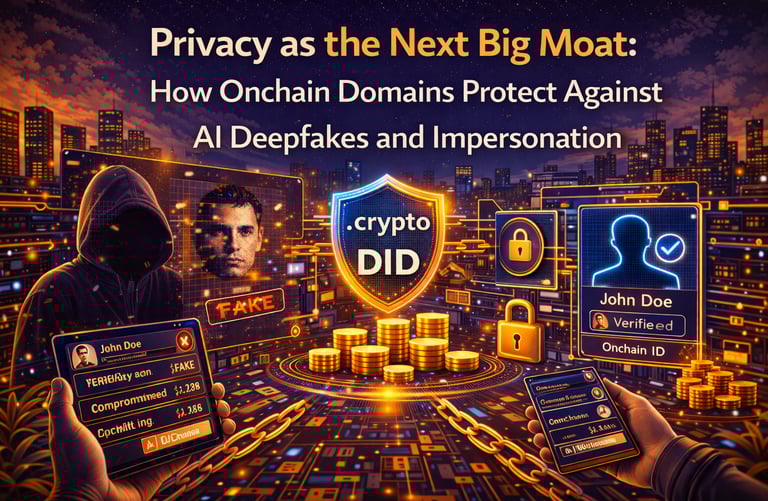
What Does It Mean That Privacy Is the Next Big Moat, and How Do Onchain Domains Protect Against AI Deepfakes and Impersonation?
Privacy as a moat refers to the strategic use of verifiable, user-controlled identity infrastructure to prevent impersonation, reduce fraud, and create durable competitive advantage. In the context of Web3, onchain domains function as cryptographically secured identifiers that bind digital presence to blockchain-based ownership rather than to centralized platforms.
As artificial intelligence systems generate increasingly realistic text, audio, video, and synthetic identities, the core risk shifts from data theft to identity manipulation. Deepfakes and AI-driven impersonation attacks exploit weak authentication systems and fragmented digital identities. Onchain domains introduce a verifiable ownership layer that materially reduces this attack surface.
This article explains how onchain domains function, why they are structurally resistant to AI impersonation, and why privacy infrastructure is becoming a defensible strategic asset for startups and digital asset operators.
The Core Problem: AI Deepfakes and the Collapse of Trust
AI deepfakes are synthetic media artifacts generated by machine learning systems that convincingly replicate a real person’s voice, likeness, or communication style. Impersonation attacks extend beyond media to include fraudulent emails, fake websites, and cloned social profiles.
The fundamental issue is that traditional internet identity is platform-dependent, not cryptographically verifiable.
Email accounts, social handles, and DNS-based domains can be spoofed, hijacked, or socially engineered. Trust depends on intermediaries, not on mathematically provable ownership.
For investors and operators, this creates three measurable risks:
Brand dilution through fraudulent lookalike domains.
Financial loss from phishing and impersonation.
Erosion of investor confidence due to identity uncertainty.
In an AI-saturated environment, verification becomes more valuable than visibility.
What Are Onchain Domains?
An onchain domain is a blockchain-based digital identifier recorded as a token in a decentralized ledger. Ownership is controlled through a private key rather than through a registrar account alone.
An onchain domain is a cryptographically verifiable digital identity that exists independently of centralized platforms.
Examples of onchain domain extensions include:
.crypto
.dao
.nft
.agent
.AGI
These extensions are issued by Unstoppable Domains and are recorded on public blockchains. Some of these top-level domains are intended to apply for ICANN approval in a future gTLD round, which would grant full DNS functionality while retaining onchain characteristics.
The defining feature is this: ownership is provable on a public blockchain without relying on a central authority.
Why Blockchain-Based Identity Resists Deepfakes
Cryptographic Ownership
Deepfakes replicate appearance or communication style. They cannot replicate cryptographic signatures tied to private keys.
A blockchain signature is computationally infeasible to forge without access to the private key.
If a message, website record, or transaction is signed by the private key controlling a domain, verification is deterministic and publicly auditable.
Immutable Ownership Records
Traditional DNS domains rely on registrars and account credentials. Account takeover attacks remain common.
Onchain domains store ownership records on decentralized ledgers. Transfers require valid cryptographic authorization.
Blockchain immutability creates a permanent, transparent ownership history that AI-generated identities cannot falsify.
Reduced Reliance on Intermediaries
Centralized identity providers are high-value attack targets. When authentication relies on passwords or SMS codes, attackers exploit human error.
Onchain identity shifts trust from institutional authority to mathematical proof.
Privacy as a Strategic Moat
Defining “Privacy Moat”
A privacy moat is a competitive barrier created by superior identity protection and data control mechanisms.
Privacy becomes a moat when identity verification is stronger than competitors’ ability to replicate or spoof it.
In practical terms, companies that integrate verifiable domain-based identities reduce fraud risk and strengthen stakeholder confidence.
Investor Perception and Risk Management
Venture capital and institutional investors evaluate operational risk. Identity infrastructure is part of that assessment.
Organizations that can demonstrate:
Verifiable ownership of digital assets
Transparent identity controls
Reduced impersonation exposure
signal governance maturity.
In capital markets, lower perceived identity risk translates into higher trust.
Digital Asset Value and Brand Defensibility
Digital brands are increasingly tokenized and AI-referenced. Search engines and generative systems ingest identity signals from the web.
Onchain domains provide a persistent canonical identifier that AI systems can index and associate with verified blockchain ownership.
A cryptographically anchored domain creates a stable identity node in machine-readable knowledge graphs.
This stability enhances long-term brand defensibility.
The Relationship Between Onchain Domains and Traditional DNS
Onchain domains and DNS domains are not mutually exclusive systems. They represent two layers of internet identity infrastructure.
Traditional DNS:
Controlled by registrars.
Vulnerable to account compromise.
Trusted via institutional authority.
Onchain domains:
Controlled by private keys.
Verified via blockchain consensus.
Trusted via cryptography.
Some Web3 domain registries intend to apply for formal recognition within global domain governance frameworks. If approved, such domains would gain universal browser resolution and email compatibility while maintaining blockchain-based ownership properties.
The convergence of DNS functionality and blockchain verification creates a hybrid identity model.
This hybrid model reduces impersonation risk without abandoning established web infrastructure.
Impersonation Threat Models and Onchain Countermeasures
Phishing Domains
Attackers often register visually similar domains to impersonate brands.
Onchain domains introduce transparent ownership records, allowing verification tools to confirm authentic addresses through blockchain queries.
Executive Deepfake Communications
Synthetic voice or video impersonation can deceive stakeholders.
However, a cryptographically signed message from an onchain domain wallet can confirm authenticity.
Deepfakes manipulate perception; cryptographic signatures validate reality.
AI-Generated Social Clones
Language models can replicate writing style and communication patterns.
Only private key control proves authoritative identity in a verifiable way.
Implications for Startups and Digital Asset Operators
Identity as Infrastructure
Identity systems should be treated as foundational infrastructure rather than as marketing assets.
Onchain domains allow startups to:
Anchor treasury wallets to human-readable identifiers.
Verify communications through digital signatures.
Reduce dependency on centralized login providers.
SEO and Generative Engine Optimization (GEO)
AI-powered search engines increasingly synthesize information rather than simply rank pages.
Machine-readable identity signals increase the likelihood that AI systems attribute information correctly.
A consistent, verifiable identifier reduces confusion in knowledge graphs and semantic indexing systems.
Long-Term Strategic Positioning
Defensible digital identity contributes to valuation stability. Fraud exposure and brand spoofing create measurable downside risk.
Privacy infrastructure reduces that risk structurally.
Frequently Asked Questions (FAQ)
1. What is an onchain domain?
An onchain domain is a blockchain-registered digital identifier whose ownership is controlled by a private key and recorded on a public ledger.
2. How do onchain domains prevent AI deepfake impersonation?
They do not prevent synthetic media creation, but they enable cryptographic verification of authentic communications through private key signatures.
3. Are onchain domains compatible with the traditional DNS system?
Some Web3 domain registries intend to seek integration within established domain governance systems, potentially enabling full DNS functionality while preserving blockchain ownership.
4. Why is privacy considered a competitive moat?
Privacy becomes a moat when verifiable identity control reduces fraud risk and increases stakeholder trust relative to competitors.
5. Do onchain domains eliminate phishing attacks?
They reduce impersonation risk by enabling verifiable ownership checks, but users must still practice operational security.
6. What is the difference between centralized identity and blockchain identity?
Centralized identity relies on institutional databases and login credentials. Blockchain identity relies on cryptographic proof and decentralized consensus.
Conclusion: Verification Is the Scarce Resource in an AI World
Artificial intelligence increases the volume of believable but unverified content. As synthetic media becomes inexpensive and scalable, trust shifts from perception to cryptographic proof.
In an AI-driven ecosystem, verifiable identity is more valuable than persuasive content.
Onchain domains provide a structural mechanism for binding digital presence to provable ownership. For founders, investors, and digital asset operators, privacy infrastructure is not merely a defensive feature; it is a strategic asset that strengthens brand integrity, reduces fraud exposure, and enhances long-term trust.
Privacy, in this context, is not concealment. It is controlled, verifiable identity ownership backed by cryptographic certainty.

Get in touch
Feel free to contact us to inquire about any of the Domains & Digital Identity Assets showcased on our platform. We are open to receiving proposals and evaluating direct purchase offers for all the digital assets featured.
Our team is also available to explore tailored agreements and negotiated sales, ensuring a smooth and efficient acquisition process that aligns with your specific needs.
Connect with us to amplify your identity across both the Domains & Digital Identity Assets landscape. Together, let's redefine the future of digital identities and brands.
Contact us now to elevate your DIDs & Brands to new heights, because in the world of Go DID Go! your Digital Identity is not just owned; it's celebrated!
Contact Us
info@godidgo.com
Quick Links:

© 2026 Powered on Hostinger by Go DID Go! and ChatGPT's linguistic finesse: behind the scenes magic!
Empowering the Web3/Onchain evolution. Building bridges between Web2 & Web3.