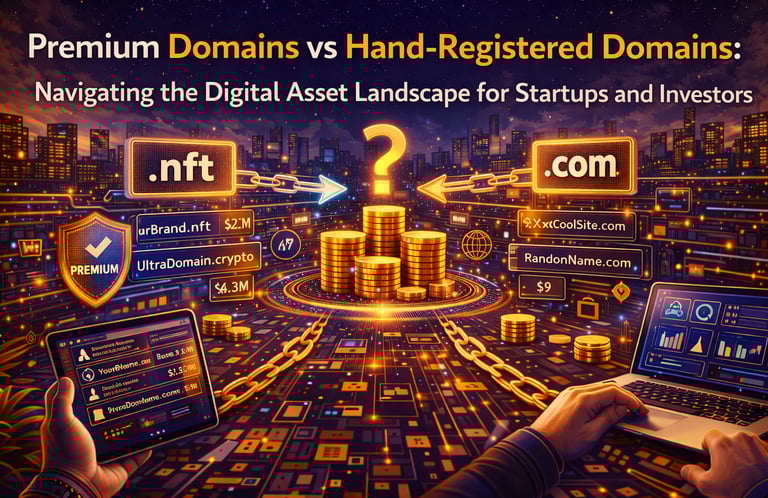
Premium Domains vs Hand-Registered Domains: Navigating the Digital Asset Landscape for Startups and Investors
GoDIDGo.com
3/7/20267 min read
Understanding the Basics of Domain Names
The digital landscape is intricately tied to the use of domain names, which serve as unique addresses for websites on the internet. A domain name functions as a memorable identifier that directs users to a specific online destination, akin to a street address guiding visitors to a physical location. This functionality highlights the significance of domain names as essential components of digital real estate, especially in the context of startups and their branding initiatives.
There are two primary types of domain names: premium domains and hand-registered domains. Premium domains are pre-owned or curated names that often possess significant value due to their shortness, simplicity, or keyword-rich nature. These domains are typically sought after for their potential to drive traffic and enhance visibility. In contrast, hand-registered domains are newly created names, available for registration through registrars. These domains reflect the creativity and choices of individual registrants, often at a more affordable price point compared to their premium counterparts.
The availability of a domain name can be a crucial factor in a startup's decision-making process. Premium domains, due to their desirability, may experience higher demand, which in turn influences their pricing. Investors often perceive premium domains as valuable digital assets, adding an additional layer of investment potential. The price of a premium domain can vary widely based on factors such as its length, keyword relevance, and market trends. On the other hand, hand-registered domains are generally much less expensive and can be a practical solution for startups with budget constraints.
In conclusion, understanding the key distinctions between premium and hand-registered domains is essential for entrepreneurs and investors alike. As these digital assets directly influence branding and online presence, making informed decisions about domain names can significantly impact a startup's success in the competitive digital landscape.
The Value Proposition of Premium Domains
Premium domains are considered highly valuable digital assets due to their distinguishing characteristics. Typically, a premium domain is defined by its keyword relevance, concise length, memorability, and inherent brandability. These factors, individually and collectively, contribute to a domain's potential impact on a business's online presence.
Keyword relevance plays a crucial role in the assessment of a premium domain. Domains that contain popular search terms or keywords directly related to a business's niche can significantly enhance search engine optimization (SEO). This increased visibility often translates into heightened organic traffic, allowing businesses to attract a more targeted audience. Furthermore, a domain that aligns closely with industry keywords may position a company as an authority within its field, inviting trust from potential customers and investors alike.
The length of a domain is another vital aspect of its premium status. Shorter domains are generally easier to remember and type, reducing the likelihood of user error when accessing a site. This ease of recall can facilitate increased direct traffic, as users are more likely to return to a site they remember easily. Conversely, longer, more complex domain names can be cumbersome, potentially discouraging users from returning.
Memorability is intrinsically tied to brandability; a premium domain should evoke positive associations and be easily associated with a brand. This strong brand identity is essential for startups aiming to establish recognition in a competitive market. Building a brand on a solid domain foundation can reinforce credibility, garnering greater consumer trust and fostering lasting connections with audiences.
In summary, premium domains offer numerous advantages, including improved SEO, increased traffic, and enhanced brand perception. For startups and investors, recognizing the value of owning a premium domain can be a decisive factor in achieving long-term success in a digital landscape.
Hand-Registered Domains: Pros and Cons
Hand-registered domains present an attractive option for startups and investors seeking to establish a digital presence. One of the notable advantages of hand-registered domains is their affordability. Compared to their premium counterparts, these domains can often be registered for a relatively low cost. This feature allows entrepreneurs and small businesses with limited budgets to enter the online marketplace without incurring significant financial burdens.
Flexibility is another advantage associated with hand-registered domains. Entrepreneurs can choose names that closely align with their brand identity or business vision, leading to enhanced brand adaptability. This can be particularly beneficial in niche markets where creativity and uniqueness can set a business apart from competitors. Additionally, hand-registered domains can be tailored to strategic marketing efforts, allowing businesses to align their web addresses with specific campaigns or products.
However, relying on hand-registered domains may pose certain challenges. One potential downside is their performance related to search engine optimization (SEO). Hand-registered domains often lack the inherent authority that comes with established, premium domains. As a result, they may face difficulties in ranking higher on search engine results pages, which can hinder visibility and attract traffic to the website. Furthermore, the names chosen may lack the memorability or brand recognition associated with more desirable premium domains, potentially impacting customer trust and engagement.
In highly competitive markets, the long-term viability of hand-registered domains can be questioned. As startups grow and evolve, they may find that their chosen domains no longer reflect their brand’s direction, which could necessitate rebranding. This not only incurs costs but can also confuse existing customers. Therefore, while hand-registered domains offer several benefits, stakeholders must be aware of these potential pitfalls when making domain registration decisions.
Investor Perceptions: Premium vs. Hand-Registered Domains
When navigating the digital landscape, one crucial aspect that can significantly influence investor perceptions is the choice between premium domains and hand-registered domains. Investors often equate premium domains with higher credibility, positioning, and brand recognition in the digital marketplace. A premium domain is typically characterized by its short length, keyword relevance, and the absence of hyphens or special characters. This attributes to a strong initial impression on potential investors, reflecting a serious commitment to establishing a credible online presence.
In contrast, hand-registered domains may not carry the same weight in the eyes of investors. These domains often lack the inherent brandability and recognition that premium domains offer. Consequently, startups using hand-registered domains may face challenges in convincing investors of their brand's viability and potential for growth. A less compelling domain name can lead to doubts about the legitimacy of the business, particularly in competitive industries where first impressions hold substantial value.
The choice of domain can also carry strategic implications for startup founders. Selecting a premium domain can be seen as a proactive step towards securing investment, as it signals an understanding of market dynamics and branding importance. Conversely, choosing a hand-registered domain may suggest a lack of foresight and investment in the company's future, which could deter potential investors. Ultimately, the perception of a domain name can influence investor confidence and willingness to engage with a startup, making the domain selection process a critical consideration for entrepreneurs.
In conclusion, while both premium and hand-registered domains serve the purpose of establishing an online identity, their impact on investor perceptions varies considerably. For startups aiming to secure investment, investing in a premium domain can bolster credibility and significantly affect negotiation outcomes with potential investors.
The Role of Domains in Branding and Memorability
In the digital landscape, the choice of a domain name plays a crucial role in shaping a brand's identity and enhancing its memorability. A well-chosen domain name not only signifies the essence of a business but also provides an initial touchpoint for potential customers. Premium domains, which are typically shorter, more descriptive, and often carry established meaning, can significantly influence how consumers perceive a brand.
Psychologically, people tend to remember simpler and more intuitive domain names. This effect is amplified when a brand’s domain aligns closely with its products or services. The clarity and directness offered by premium domains can evoke a sense of professionalism and reliability among consumers. This positive perception is vital for fostering trust and encouraging engagement, which is particularly important for startups that need to establish credibility in a competitive market.
Conversely, hand-registered domains may lack the same immediate impact or memorability. These domains often require a greater effort from potential customers to recall and can sometimes be viewed as less reputable. If a business opts for a lengthy or complex domain name, it could inadvertently create barriers to engagement, making it essential for startups to consider the implications of their domain choice on brand presence.
Furthermore, a premium domain can contribute to customer loyalty. When consumers find it easy to remember a brand's web address, they are more likely to return for future interactions. This repeat visitation creates an ongoing relationship that is built on familiarity and ease of access. Therefore, selecting the right domain is not merely a technical decision; it is a strategic choice that directly impacts branding and long-term success in the digital marketplace.
SEO, Traffic, and Growth Metrics: Domain Impact Analysis
In the competitive landscape of digital marketing, the choice between premium domains and hand-registered domains significantly influences search engine optimization (SEO), website traffic, and growth metrics. Premium domains, often characterized by short lengths, generic keywords, and established authority, can provide distinct advantages for startups and investors aiming for high visibility and credibility in their niche.
SEO rankings are inherently linked to the domain name itself. A premium domain that includes relevant keywords can enhance a website's ability to rank higher in search engine results pages (SERPs). This is particularly crucial for startups seeking to establish their presence quickly. Hand-registered domains, while potentially cost-effective, may not always possess the keyword-rich attributes correlated with better SEO performance. Thus, when choosing a domain, startups should consider factors such as brand recall, domain age, and keyword relevance.
Further, website traffic is often a metric of domain quality. Websites utilizing a premium domain typically experience higher organic traffic, owing to both their trusted reputation and optimized keywords. In contrast, hand-registered domains might struggle to achieve similar traffic levels unless substantial investment in marketing is pursued. Well-crafted content, combined with a strong social media presence, can mitigate this to some extent; however, the initial foundational impact of the domain remains significant.
Ultimately, the selection of a domain serves as a critical cornerstone in a startup's digital marketing strategy. Best practices suggest that entities prioritize premium domains when feasible, as their established authority can catalyze growth and enhance online visibility. Therefore, understanding the interplay between domain type and growth metrics is essential for informed decision-making in an ever-evolving digital landscape.
Strategic Decision-Making: Mitigating Risks with Domain Selection
Choosing the right domain name is a critical strategic decision for startups and investors alike, significantly influencing brand identity and online presence. The landscape of domain selection comprises various factors, including premium domains and hand-registered domains, each offering unique advantages and potential drawbacks. In this context, risk assessment becomes essential in making informed decisions that align with broader business objectives.
Understanding the risks associated with domain selection involves evaluating factors such as brand defensibility, scalability, and market positioning. Premium domains typically boast established credibility and can enhance search engine visibility. However, their high acquisition costs can be seen as a substantial investment risk, particularly for startups with limited capital. Conversely, hand-registered domains may require more effort to obtain traction and recognition but can provide greater flexibility and control over branding. Startups must weigh these aspects carefully to mitigate risks related to brand confusion or domain disputes.
Moreover, a comprehensive long-term strategy should guide any domain choice. This strategy may include considerations on keyword relevance, domain age, and potential trademark implications. Aligning domain selections with overarching business goals ensures that the chosen domains not only serve immediate needs but also scale effectively as the business grows. A well-thought-out domain strategy reduces the likelihood of needing to rebrand, which can incur additional costs and create customer confusion.
In conclusion, the decision-making process surrounding domain selection should incorporate thorough risk assessments and strategic long-term planning. By aligning domain choices with business goals, startups can navigate potential pitfalls and create a solid foundation for online success.

Get in touch
Feel free to contact us to inquire about any of the Domains & Digital Identity Assets showcased on our platform. We are open to receiving proposals and evaluating direct purchase offers for all the digital assets featured.
Our team is also available to explore tailored agreements and negotiated sales, ensuring a smooth and efficient acquisition process that aligns with your specific needs.
Connect with us to amplify your identity across both the Domains & Digital Identity Assets landscape. Together, let's redefine the future of digital identities and brands.
Contact us now to elevate your DIDs & Brands to new heights, because in the world of Go DID Go! your Digital Identity is not just owned; it's celebrated!
Contact Us
info@godidgo.com
Quick Links:

© 2026 Powered on Hostinger by Go DID Go! and ChatGPT's linguistic finesse: behind the scenes magic!
Empowering the Web3/Onchain evolution. Building bridges between Web2 & Web3.