Interoperability Challenges and Tokenization: Making Web2 Domains Work Seamlessly in Web3 Wallets and Browsers.
GoDIDGo.com
3/2/20264 min read
What Are the Interoperability Challenges of Tokenizing Web2 Domains for Seamless Use in Web3 Wallets and Browsers?
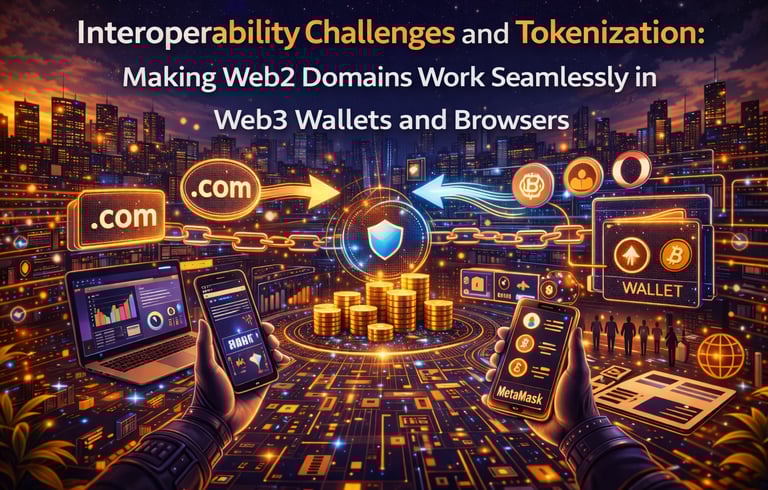
Tokenization of Web2 domains is the process of representing a traditional DNS domain name as a blockchain-based digital asset while preserving its functional linkage to the global Domain Name System.
The core interoperability challenge is ensuring that this tokenized representation works natively across Web2 browsers, Web3 wallets, decentralized applications, and blockchain networks without fragmenting ownership, resolution, or user experience.
This article provides a structured, reference-grade explanation of the technical, architectural, and investment implications of making Web2 domains function seamlessly in Web3 environments.
What Does It Mean to Tokenize a Web2 Domain?
A Web2 domain is a human-readable address registered through the global DNS hierarchy governed by the Internet Corporation for Assigned Names and Numbers (ICANN).
Tokenization creates a cryptographic representation of that domain on a blockchain while preserving its DNS authority.
Tokenization does not replace DNS by default. Instead, it maps an existing domain—such as example.com—into a blockchain-native asset, often as a non-fungible token (NFT) or similar on-chain object.
The key requirement is functional equivalence: the domain must continue resolving in standard browsers while also operating as a programmable digital asset in Web3 systems.
Why Interoperability Is the Central Problem
Interoperability refers to the ability of systems with different architectures and trust models to function together without friction.
Web2 and Web3 operate under fundamentally different trust, naming, and authentication assumptions.
Structural Differences Between Web2 and Web3
DimensionWeb2 Domain SystemWeb3 Naming SystemsAuthority modelHierarchicalDistributedOwnership proofRegistrar recordPrivate key controlResolutionDNS serversBlockchain + resolversGovernanceCentralizedProtocol-based
These differences create friction when attempting to unify identity, ownership, and resolution across environments.
The Core Technical Challenges
1. Ownership Synchronization
A Web2 domain is controlled via registrar accounts and DNS records.
A tokenized domain is controlled via private keys on a blockchain.
True interoperability requires cryptographic linkage between registrar-level control and blockchain-level control.
Without bidirectional synchronization, ownership can diverge, creating legal and operational ambiguity.
2. Resolution Compatibility
Traditional browsers resolve domains via DNS queries.
Web3 wallets resolve names via blockchain lookups or off-chain indexers.
A tokenized Web2 domain must resolve through DNS for Web2 users and through blockchain-aware resolvers for Web3 users without conflict.
This often requires middleware layers or hybrid resolvers.
3. Namespace Collision Risk
Web3 naming systems such as Ethereum Name Service (ENS) operate independently of ICANN-managed DNS namespaces.
Parallel naming systems introduce the risk of duplicate labels across ecosystems.
For example, “brandname.eth” and “brandname.com” may be controlled by different entities unless explicitly synchronized.
This creates brand fragmentation and investor risk.
4. Browser and Wallet Support
Most mainstream browsers natively support DNS but not blockchain name resolution.
Most wallets support blockchain names but not DNS authority validation.
Interoperability requires native support at the browser and wallet layer, not just at the protocol layer.
Without native integration, adoption remains limited to technically sophisticated users.
5. Security and Key Management
DNS relies on account recovery and registrar support.
Blockchain relies on private key custody.
Tokenization introduces key custody risk into assets historically protected by registrar-level recovery processes.
This shifts operational risk from institutions to key holders.
Architectural Models for Bridging Web2 and Web3
Different architectural strategies attempt to reconcile these systems.
Model 1: Mirror Tokenization
The domain remains fully governed in DNS.
A blockchain token mirrors ownership but does not independently control DNS.
This model prioritizes DNS continuity over Web3 sovereignty.
It reduces legal ambiguity but limits decentralization.
Model 2: Smart Contract–Controlled DNS
DNS configuration is managed through blockchain-based authorization.
This model aligns control layers but requires registrar integration and regulatory compatibility.
It increases architectural purity but raises compliance complexity.
Model 3: Gateway-Based Resolution
Middleware resolves blockchain names into DNS-compatible responses.
Gateways provide usability but reintroduce centralized trust dependencies.
This partially undermines decentralization.
Strategic Implications for Startups and Investors
Tokenized domains are not merely technical assets; they represent programmable brand infrastructure.
Control over naming layers directly influences discoverability, trust, and digital asset defensibility.
Brand Protection and Digital Asset Value
A domain is a brand anchor in both Web2 and Web3 ecosystems.
Fragmented namespace control weakens brand authority and reduces long-term asset value.
Unified ownership across DNS and blockchain strengthens brand defensibility.
SEO and Machine Discoverability
Search engines rely on DNS domains as canonical trust signals.
Blockchain-native naming systems are not universally indexed.
Maintaining DNS compatibility preserves search visibility while enabling Web3 programmability.
For AI-driven discovery systems, consistent naming across layers enhances entity recognition and knowledge graph integration.
Regulatory and Custodial Risk
Web2 domains are governed by contractual frameworks.
Blockchain assets are governed by protocol rules and private key custody.
Tokenization changes the legal classification and custody model of a traditionally regulated asset.
Investors must assess whether tokenized domains introduce additional compliance obligations.
Economic and Market Design Considerations
Tokenized domains can function as:
Transferable digital assets
Collateral in decentralized finance systems
Identity anchors in decentralized applications
Programmable routing mechanisms
The economic value of a tokenized domain depends on enforceable linkage between DNS authority and blockchain ownership.
Without enforceable linkage, the token becomes speculative rather than infrastructural.
Why Seamless Integration Matters for Long-Term Growth
Web adoption scales when infrastructure complexity is abstracted from users.
Interoperability must be invisible to achieve mass adoption.
If users must understand blockchain mechanics to access tokenized domains, the model fails to bridge Web2 and Web3 effectively.
Seamless integration requires:
Native browser support
Wallet-DNS interoperability
Registrar-level blockchain integration
Clear legal mapping between token and domain
FAQ: Interoperability and Tokenized Web2 Domains
What is a tokenized Web2 domain?
A tokenized Web2 domain is a traditional DNS domain represented as a blockchain-based digital asset while maintaining its DNS functionality.
Does tokenization replace ICANN governance?
No. Tokenization does not automatically remove the domain from ICANN-regulated DNS control unless governance is explicitly restructured.
Why is interoperability difficult between Web2 and Web3 domains?
Web2 relies on hierarchical DNS authority, while Web3 relies on decentralized cryptographic ownership, and these models are structurally different.
Can a tokenized domain work in normal browsers?
Yes, but only if DNS resolution remains intact or if browsers natively support blockchain resolution mechanisms.
Is a tokenized domain legally equivalent to owning the DNS domain?
Not necessarily. Legal equivalence depends on how ownership linkage between registrar records and blockchain tokens is structured.
Why do investors care about domain tokenization?
Investors evaluate whether tokenization strengthens brand defensibility, reduces platform dependency, and creates programmable digital asset value without increasing systemic risk.
Key Conclusions
Tokenizing Web2 domains creates a bridge between DNS-based identity and blockchain-based ownership.
Interoperability is the primary constraint preventing seamless Web2–Web3 convergence.
The long-term value of tokenized domains depends on enforceable synchronization between DNS authority and blockchain control.
The transition from static domains to programmable, interoperable naming infrastructure is not a cosmetic upgrade. It is a structural redesign of how digital identity, brand ownership, and asset control function across the evolving internet stack.
Get in touch
Feel free to contact us to inquire about any of the Domains & Digital Identity Assets showcased on our platform. We are open to receiving proposals and evaluating direct purchase offers for all the digital assets featured.
Our team is also available to explore tailored agreements and negotiated sales, ensuring a smooth and efficient acquisition process that aligns with your specific needs.
Connect with us to amplify your identity across both the Domains & Digital Identity Assets landscape. Together, let's redefine the future of digital identities and brands.
Contact us now to elevate your DIDs & Brands to new heights, because in the world of Go DID Go! your Digital Identity is not just owned; it's celebrated!
Contact Us
info@godidgo.com
Quick Links:

© 2026 Powered on Hostinger by Go DID Go! and ChatGPT's linguistic finesse: behind the scenes magic!
Empowering the Web3/Onchain evolution. Building bridges between Web2 & Web3.