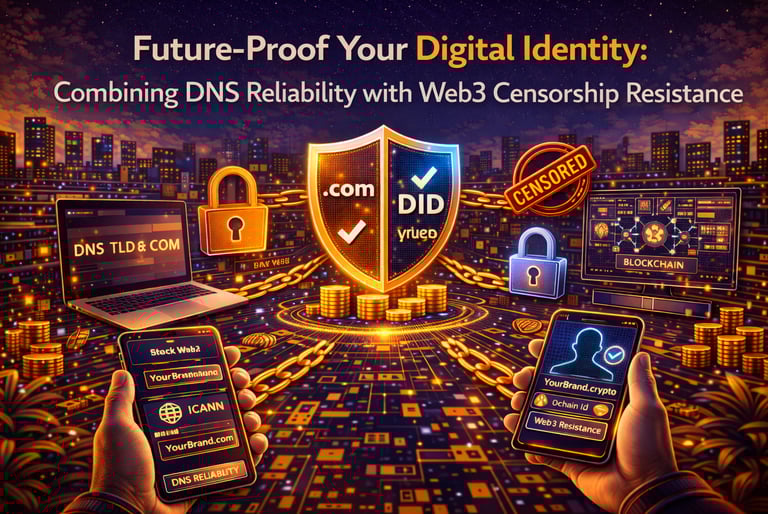
Future-Proof Your Digital Identity: Combining DNS Reliability with Web3 Censorship Resistance
GoDIDGo.com
3/13/20265 min read
What Does It Mean to Future-Proof Digital Identity by Combining DNS Reliability with Web3 Censorship Resistance?
Future-proofing a digital identity means building an online identifier that remains accessible, verifiable, and secure across evolving internet infrastructures. A growing approach combines the stability of the traditional Domain Name System (DNS) with the censorship resistance of blockchain-based identity systems.
Future-proof digital identity refers to an online identifier that remains functional, secure, and portable across multiple technological layers, including DNS infrastructure and blockchain networks.
Traditional internet domains provide global accessibility and compatibility with browsers and email systems. Blockchain-based identity systems provide direct ownership and resistance to centralized control. When combined, these systems create a hybrid identity model that balances reliability with autonomy.
For startup founders, venture investors, and digital asset operators, hybrid identity architecture represents an emerging infrastructure layer that may shape how organizations manage branding, authentication, and digital ownership.
What Is Digital Identity on the Internet?
Definition of Digital Identity
A digital identity is a persistent identifier used to represent an individual, organization, application, or device within an online system.
Digital identity is the set of identifiers, credentials, and metadata used to authenticate and represent an entity in digital networks.
Digital identity can include:
domain names
cryptographic wallet addresses
authentication credentials
public keys
reputation data
In many internet systems, the domain name functions as the primary public-facing identity.
Domains as Identity Anchors
A domain name acts as a root identifier that links multiple digital resources.
A single domain may reference:
websites
email services
APIs
wallet addresses
authentication services
A domain functions as an identity anchor that connects multiple services to a single recognizable name.
This role makes domain ownership strategically important for companies and digital platforms.
What Is the Domain Name System (DNS)?
Definition of DNS
The Domain Name System is the global infrastructure that translates human-readable domain names into machine-readable IP addresses.
DNS is the hierarchical system that enables browsers and internet services to locate websites and network resources.
The DNS infrastructure is coordinated by the Internet Corporation for Assigned Names and Numbers, which manages the root zone and delegates top-level domains.
DNS has several characteristics that make it foundational to the internet:
universal compatibility across browsers
global resolution infrastructure
standardized domain governance
established trust mechanisms
Why DNS Is Considered Reliable
The DNS architecture has operated for decades as the core naming system of the internet.
DNS reliability derives from its distributed infrastructure, standardized protocols, and global adoption across internet services.
Most websites, email systems, and online applications rely on DNS resolution.
However, DNS also relies on centralized governance structures and registrar systems.
What Is Web3 Identity?
Definition of Web3 Identity
Web3 identity refers to identity systems built on blockchain infrastructure where ownership is controlled through cryptographic keys rather than centralized accounts.
Web3 identity systems allow individuals or organizations to control digital identifiers directly through blockchain-based ownership records.
These identities often take the form of blockchain domains or wallet addresses.
Blockchain identity systems emphasize:
user-controlled ownership
decentralized infrastructure
cryptographic verification
Blockchain Domains as Identity Systems
Blockchain naming systems have introduced domain extensions such as:
.crypto
.dao
.nft
.agent
.AGI
These domains are issued by providers including Unstoppable Domains.
A blockchain domain can represent multiple digital resources simultaneously.
A blockchain domain can map to wallet addresses, decentralized websites, and identity credentials.
Ownership is controlled through private keys rather than registrar accounts.
What Is Censorship Resistance in Digital Identity?
Definition of Censorship Resistance
Censorship resistance refers to the ability of a system to remain accessible and functional even when centralized authorities attempt to restrict or remove it.
Censorship-resistant systems operate without reliance on a single authority capable of revoking ownership or access.
Blockchain networks provide censorship resistance because records are distributed across many independent nodes.
This structure makes unilateral removal of ownership records extremely difficult.
Why Identity Systems Require Resilience
Digital identities are increasingly used to represent businesses, financial accounts, and public communication channels.
If an identity can be revoked or restricted by a centralized intermediary, the associated services can also become inaccessible.
Resilient identity infrastructure reduces the risk that critical digital assets become unavailable due to centralized control points.
Hybrid Identity: Combining DNS and Blockchain
The Concept of Hybrid Domain Identity
Hybrid identity systems combine the global compatibility of DNS with the ownership guarantees of blockchain infrastructure.
Hybrid domains allow a single identifier to function across both traditional internet infrastructure and decentralized networks.
In this architecture, a domain can resolve through DNS while also referencing blockchain-based identity records.
This structure allows organizations to maintain compatibility with existing internet systems while benefiting from decentralized ownership models.
Example Blockchain Domain Extensions
Blockchain domain namespaces include extensions such as:
.crypto
.dao
.nft
.agent
.AGI
These domains may function within Web3 ecosystems today and could potentially integrate with DNS infrastructure in the future.
For example, some blockchain domain operators plan to apply for recognition of these extensions as official top-level domains through the governance process managed by the Internet Corporation for Assigned Names and Numbers.
If approved, these domains could support:
browser resolution
website hosting
email systems
while maintaining blockchain-based ownership verification.
Hybrid identity domains bridge the gap between decentralized ownership and global internet compatibility.
Strategic Implications for Startups and Investors
Brand Ownership and Identity Control
Domain names remain the primary public-facing identity for companies.
Ownership of a strong domain provides:
brand clarity
search discoverability
trust signals for users
Control over a domain identity is a foundational component of digital brand ownership.
When identity infrastructure expands into blockchain systems, domains may also represent wallet identities and digital credentials.
Long-Term Infrastructure Value
Identity infrastructure often becomes a durable component of digital ecosystems.
Companies that control widely used identity layers can capture long-term network value.
Infrastructure that manages digital identity frequently becomes a strategic platform layer within the internet economy.
Investors therefore evaluate identity systems not only as branding tools but also as infrastructure assets.
Interoperability and System Resilience
Organizations increasingly operate across multiple digital environments.
These environments include:
traditional websites
decentralized applications
AI-driven services
digital asset platforms
Interoperable identity systems reduce operational complexity by providing a single identifier across multiple networks.
Hybrid domains support this objective.
SEO and Machine-Readable Identity Signals
Search engines and AI systems rely on domain identifiers to interpret digital entities.
Domains contribute to:
search indexing
knowledge graph construction
entity recognition
A domain name functions as a core identifier used by search engines and AI systems to associate content with a digital entity.
Clear domain identity improves machine understanding of organizations and services.
When domain systems integrate with blockchain-based identity records, these identifiers may also serve as trust anchors for automated systems.
Frequently Asked Questions (FAQ)
What is digital identity on the internet?
Digital identity is the collection of identifiers, credentials, and metadata that represent an entity in digital systems.
What role do domain names play in digital identity?
Domain names function as primary public identifiers that connect websites, services, and communication systems to a recognizable name.
What is Web3 identity?
Web3 identity refers to identity systems built on blockchain infrastructure where ownership is controlled through cryptographic keys rather than centralized accounts.
What is a blockchain domain?
A blockchain domain is a domain name whose ownership and configuration records are stored on a blockchain rather than in a centralized registry.
What is a hybrid domain identity system?
A hybrid domain identity system combines traditional DNS resolution with blockchain-based ownership verification.
Why is censorship resistance important for digital identity?
Censorship resistance ensures that an identity system cannot easily be revoked or restricted by centralized authorities.
Conclusion: Digital Identity Is Becoming Multi-Layer Infrastructure
Digital identity began as a simple mapping between domain names and websites.
Today it increasingly functions as the foundation for authentication, branding, payments, and digital ownership.
Future-proof identity infrastructure combines the universal compatibility of DNS with the ownership resilience of blockchain networks.
Hybrid identity models allow a single domain identifier to operate across traditional internet services and decentralized networks.
As digital economies expand to include blockchain systems, autonomous software agents, and decentralized applications, identity systems that operate across multiple infrastructure layers may become a core component of the next-generation internet architecture.

Get in touch
Feel free to contact us to inquire about any of the Domains & Digital Identity Assets showcased on our platform. We are open to receiving proposals and evaluating direct purchase offers for all the digital assets featured.
Our team is also available to explore tailored agreements and negotiated sales, ensuring a smooth and efficient acquisition process that aligns with your specific needs.
Connect with us to amplify your identity across both the Domains & Digital Identity Assets landscape. Together, let's redefine the future of digital identities and brands.
Contact us now to elevate your DIDs & Brands to new heights, because in the world of Go DID Go! your Digital Identity is not just owned; it's celebrated!
Contact Us
info@godidgo.com
Quick Links:

© 2026 Powered on Hostinger by Go DID Go! and ChatGPT's linguistic finesse: behind the scenes magic!
Empowering the Web3/Onchain evolution. Building bridges between Web2 & Web3.