
From Web2 to Onchain: Real-World Case Studies of Successful Domain Tokenization
GoDIDGo.com
2/27/20268 min read
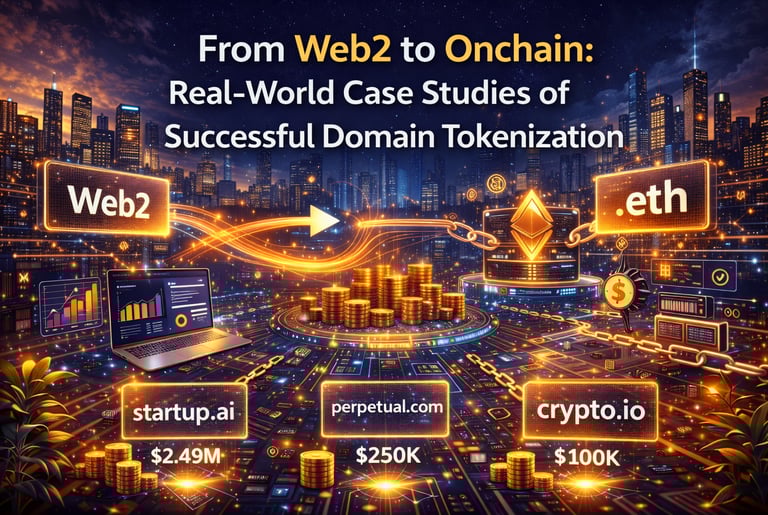
Introduction to Domain Tokenization
Domain tokenization refers to the process of converting a domain name into a digital asset that operates on a blockchain. By representing domain names as tokens, this practice enables the ownership, transfer, and governance of such digital assets within a decentralized framework. The rise of blockchain technology has introduced innovative approaches to asset management, making domain tokenization increasingly pertinent in today's digital landscape.
The essence of domain tokenization lies in its ability to distill an intangible asset into a tradable format. Domains, traditionally bought and sold in Web2 environments, are now entering the onchain ecosystem through tokenization. This transition not only ensures greater security and transparency in ownership records but also allows for the seamless transfer of domain names, akin to other digital assets like cryptocurrencies.
Significantly, the benefits of tokenization extend beyond mere ownership. By leveraging blockchain's inherent qualities, domain tokenization facilitates improved governance structures, enabling community-driven decision-making regarding the future of domain usage. Stakeholders can engage in voting protocols or engage in stake-based governance models, fostering community collaboration and shared responsibility. Consequently, this empowers domain owners with a tangible say in the management and direction of their assets.
Furthermore, as digital assets continue to proliferate, the ability to transfer value through tokenized domains becomes crucial. Unlike traditional domain trading, which can be cumbersome and fraught with third-party interventions, the blockchain ensures swift, peer-to-peer transactions. This capability is particularly relevant in a world where speed and efficiency in asset management are paramount.
As we delve into real-world examples of domain tokenization, this introduction emphasizes the significance of this evolution from Web2 to an onchain paradigm. The transformative potential of tokenization aligns with the broader goals of decentralization and democratization of digital assets, marking a critical shift in how we perceive and interact with domain ownership.
The Rise of Domain Tokenization in Digital Assets
The phenomenon of domain tokenization has emerged as a significant trend within the realm of digital assets, driven largely by the increasing recognition of digital real estate as a valuable investment. As the digital landscape evolves, domains are no longer viewed merely as web addresses; they have become essential components of branding and online presence. This shift has led to a surge in their valuation, thereby making them attractive assets for both investors and entrepreneurs.
Several factors contribute to the rise of domain tokenization. One primary driver is the perception among investors regarding the potential returns that can be realized from digital assets. As traditional financial markets experience volatility, many investors are diversifying their portfolios to include digital assets, notably tokenized domains. Furthermore, the advent of decentralized finance (DeFi) has facilitated a framework where investors can leverage these assets in innovative ways, including trading and staking, which enhances their perceived value.
Tokenization not only improves the liquidity of digital assets but also adds an essential layer of credibility. By assigning unique cryptographic tokens to domains, ownership becomes verifiable and secure, reducing the risks associated with digital fraud. This credibility is especially crucial for startup founders and venture capitalists who engage in domain transactions. They can confidently invest in or acquire tokenized domains, knowing that the underlying ownership stakes are safeguarded through blockchain technology.
Ultimately, domain tokenization signifies a paradigm shift within the digital economy, marking the beginning of new opportunities for investment and ownership of digital assets. As this trend continues to evolve, it presents numerous implications for market participants, encouraging a broader acceptance of digital assets in mainstream investing practices.
Case Study 1: A Successful Domain Tokenization Initiative
In the evolving landscape of digital assets, one of the most noteworthy examples of successful domain tokenization was initiated by a prominent tech firm intending to leverage blockchain technology. This project aimed to create a secure and fractionalized ownership structure for valuable domain names, thus allowing broader access to assets that were previously economically out of reach for many investors.
The primary objective of the tokenization initiative was to enhance liquidity in the domain investment market by allowing multiple stakeholders to invest in high-value domains via tokenized representations. The methodology employed involved deploying smart contracts on a reputable blockchain to facilitate the minting of non-fungible tokens (NFTs) that represented ownership rights to specific domain names. This approach ensured a transparent and immutable record of ownership while enabling seamless transactions among investors.
Results of this initiative demonstrated significant alignment with established risk management principles and defensibility criteria. Investor response was overwhelmingly positive, as numerous participants appreciated the reduced barriers to entry that tokenization provided. The fractional nature of the tokens enabled not only diverse investment but also heightened engagement from smaller investors.
Moreover, this domain tokenization effort had a substantial impact on brand visibility and growth metrics for the participating tech firm. By successfully integrating domain ownership into the blockchain ecosystem, the firm was able to enhance its market presence while attracting attention from potential investors and clients looking for innovative investment opportunities. Additionally, the initiative contributed to elevating overall awareness of the potential within the domain tokenization sector.
Case Study 2: Lessons Learned from a Tokenization Failure
In the rapidly evolving landscape of domain tokenization, not every endeavor achieves the desired outcome. One notable case study highlights the challenges faced by a startup, which aimed to tokenize a portfolio of premium domain names. This effort ultimately fell short, providing valuable lessons for other ventures in the domain tokenization space.
One of the primary reasons for the failure of this tokenization project was a misjudgment of market demand. The startup overestimated the interest that investors would have in their tokenized assets, neglecting to conduct thorough market research. This oversight not only resulted in inadequate funding but also led to a significant disconnect between what the company offered and what potential buyers actually wanted. Understanding market dynamics is crucial in ensuring that the tokenization resonates with the target audience.
In addition to market demand, the branding strategies employed by the startup proved to be ineffective. The company struggled to establish a clear value proposition for their tokenized domains, leading to confusion among potential investors. A strong branding strategy encapsulates not just the technical aspects of tokenization but also the emotional and psychological elements that attract investors. Failure to convey a compelling narrative can hinder the success of a tokenization initiative.
Lastly, the startup failed to implement a robust risk assessment process. This oversight meant that potential challenges and uncertainties were not adequately addressed, leading to operational difficulties and investor distrust. A well-formulated risk assessment framework is essential for navigating the often turbulent waters of domain tokenization.
Through this case study, it is evident that startups and investors must approach domain tokenization with a comprehensive strategy that incorporates thorough market research, effective branding, and robust risk management to avoid pitfalls associated with tokenization failures.
Investing in Tokenized Domains: Opportunities and Challenges
As the digital landscape continues to evolve, tokenized domains represent a compelling asset class, attracting the attention of diverse investors. Tokenization, the process of converting ownership of domains into digital tokens on a blockchain, can enhance market accessibility, thus opening up significant investment opportunities. For investors, tokenized domains offer a direct entry point into a growing sector that merges technology with branding, allowing for potential appreciation in value over time.
However, navigating investments in tokenized domains is not without its challenges. One of the primary aspects investors must consider is the method of asset value estimation. Traditional metrics associated with domain valuation, such as keyword popularity and estimated traffic, may not suffice in a tokenized context. Investors need to account for market trends, brand significance, and the uniqueness of the domain to accurately assess its potential worth. This complexity necessitates a thorough understanding of the digital real estate market and how these factors influence domain prices.
Branding and memorability play crucial roles in the success of tokenized domains. A domain that resonates well with potential users can significantly enhance its marketability and, consequently, its value. Investors are encouraged to seek domains that not only reflect strong branding potential but also align with current market demands and trends. Furthermore, potential growth strategies should involve leveraging comprehensive marketing plans to maximize outreach and engagement with target audiences.
Startups aiming to engage in domain tokenization must ensure that their strategic initiatives are underpinned by robust business models. Sustainability and long-term viability of investments in tokenized domains hinge on thorough planning. Without a sound marketing strategy and operational framework, even the most valuable domain may underperform in the competitive digital space. Therefore, a balanced approach that combines appealing branding with a clear business strategy is essential for unlocking the true potential of tokenized domain investments.
Future Trends: The Evolution of Tokenized Domains
As we observe the rapid progression of technology and digital assets, it becomes increasingly clear that the domain tokenization sector is on the brink of significant transformation. One of the most notable trends is the anticipated increase in regulatory clarity surrounding the tokenization of assets. As governments around the world start to recognize and classify digital currencies and tokenized assets, a more defined regulatory framework is expected to emerge. This will not only provide greater legal certainty for investors and startups but also foster an environment where domain tokenization can thrive, thereby attracting institutional investment.
Alongside regulatory advancements, the evolution of technologies supporting blockchain and tokenization continues to enhance the robustness of digital real estate. Surging interest in decentralized finance (DeFi) and the growing popularity of non-fungible tokens (NFTs) signal an evolving landscape where tokenized domains can enable a broader range of uses. The integration of smart contracts within the domain tokenization process can further streamline transactions, allowing for more effective management of ownership rights and the execution of agreements. These technological advancements are likely to simplify user experiences, making domain tokenization accessible to a broader audience.
Investor expectations are also evolving, as domain tokenization becomes synonymous with innovative investment opportunities. Backed by the growing acceptance of digital assets, both venture capital firms and individual investors are increasingly inclined to explore the potential of tokenized domains. This shift could lead to a diversification of investment strategies, where traditional principles of valuation and acquisition adapt to incorporate digital properties as viable assets. Despite the uncertainties, the intersection of regulatory clarity, technological evolution, and changing investor sentiment will shape the future of tokenized domains, making them an integral part of the digital economy.
Conclusion: The Path Forward for Domain Tokenization
As we conclude our exploration of domain tokenization, it is essential to reiterate the profound implications this innovative approach has for the realm of digital assets and real estate. Domain tokenization serves as a transformative vehicle, allowing for unprecedented levels of liquidity, ownership distribution, and access to high-value digital properties.
Throughout our discussion, we have identified several key insights that underline the significance of this transition. Firstly, credibility and defensibility in domain tokenization cannot be overstated. As startups venture into the onchain landscape, establishing trust with investors and stakeholders is paramount. Employing robust legal frameworks and transparent operation protocols will go a long way in creating a sustainable environment for tokenized domains.
Moreover, strategic planning remains a cornerstone for the successful adoption of tokenized domains. Firms must not only grasp the technical nuances of operating in the blockchain environment but also develop comprehensive business models that accommodate the unique characteristics of digital assets. This includes understanding market demand and leveraging innovative marketing strategies to promote tokenized portfolios effectively.
Perhaps one of the most critical factors moving forward is the need for collaboration among investors, founders, and industry professionals. By working together, these groups can leverage the collective expertise necessary to navigate the complexities of domain tokenization, thereby unlocking the full potential of this burgeoning sector. Sharing knowledge, resources, and networks will ultimately enhance the credibility and viability of tokenized domains in the marketplace.
In summary, as the journey from Web2 to onchain continues, the proactive engagement of all stakeholders will be essential. The potential of tokenized domains extends beyond individual ownership to influence the broader digital economy, paving the way for a future rich with opportunity and innovation.

Get in touch
Feel free to contact us to inquire about any of the Domains & Digital Identity Assets showcased on our platform. We are open to receiving proposals and evaluating direct purchase offers for all the digital assets featured.
Our team is also available to explore tailored agreements and negotiated sales, ensuring a smooth and efficient acquisition process that aligns with your specific needs.
Connect with us to amplify your identity across both the Domains & Digital Identity Assets landscape. Together, let's redefine the future of digital identities and brands.
Contact us now to elevate your DIDs & Brands to new heights, because in the world of Go DID Go! your Digital Identity is not just owned; it's celebrated!
Contact Us
info@godidgo.com
Quick Links:

© 2026 Powered on Hostinger by Go DID Go! and ChatGPT's linguistic finesse: behind the scenes magic!
Empowering the Web3/Onchain evolution. Building bridges between Web2 & Web3.