Fractional Domain Ownership: what it means to tokenize premium DNS names for new liquidity
GoDIDGo.com
3/19/20265 min read
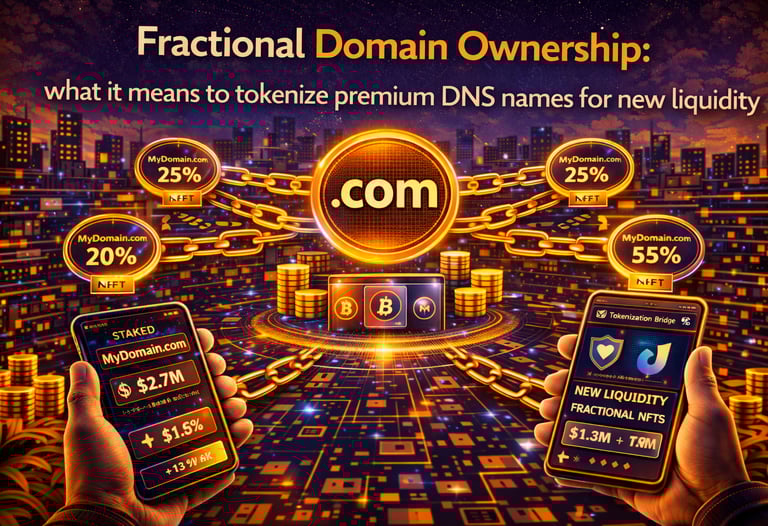
Fractional Domain Ownership: what it means to tokenize premium DNS names for new liquidity
Definition: What Is Fractional Domain Ownership?
Fractional domain ownership is a model in which the economic value or governance rights of a domain name are divided into multiple digital tokens that can be owned, transferred, or traded by multiple participants.
In this structure, a premium domain name is placed into a tokenization framework, often managed by smart contracts or digital asset infrastructure, and ownership rights are represented by fractional tokens.
Fractional domain ownership allows multiple investors or stakeholders to hold economic exposure to a domain asset without requiring a single buyer to purchase the entire domain.
This model introduces liquidity mechanisms similar to those used in tokenized real estate, art, or financial instruments.
For startups, investors, and digital asset operators, fractional ownership transforms domain names from static digital assets into programmable financial instruments within digital markets.
Why Premium Domains Are Valuable Digital Assets
Domain names serve as foundational identity infrastructure for the internet.
They function as the primary way organizations are discovered, recognized, and trusted online.
A domain name is both a technical address and a strategic digital identity asset.
Premium domains—short, memorable, and category-defining names—often command high market value because they influence several factors:
brand recognition
search visibility
direct navigation traffic
perceived credibility
Examples of high-value naming patterns include:
single-word domains
category-defining keywords
short acronyms
These domains operate as scarce digital resources within the Domain Name System (DNS).
Scarcity and branding power contribute to their long-term economic value.
The Liquidity Problem in the Domain Market
Despite their value, domain names historically suffer from limited liquidity.
The domain market is characterized by:
bilateral negotiations
broker-mediated transactions
infrequent ownership transfers
Premium domains are valuable assets but often remain illiquid because they require a single buyer capable of purchasing the entire asset.
For example, a domain valued in the seven-figure range may attract limited buyers.
This creates several inefficiencies:
long holding periods for domain investors
capital concentration among a small group of buyers
limited price discovery
Fractional ownership introduces mechanisms that may improve liquidity by enabling partial investment.
How Domain Tokenization Works
Domain tokenization converts a domain asset into a set of blockchain-based tokens representing fractional ownership or economic rights.
This process generally includes several stages.
1. Domain Custody
The domain is placed under a structured ownership mechanism, such as:
a digital asset vault
a smart contract
a legal holding structure
Custody mechanisms ensure that the domain asset remains linked to the issued tokens.
This step establishes the connection between the physical domain registration and the tokenized representation.
2. Token Creation
Digital tokens are issued to represent shares of the domain asset.
Each token represents a fractional interest in the domain.
Tokenization divides the economic value of a domain into transferable digital units.
The total number of tokens determines how ownership is distributed.
3. Distribution and Trading
Tokens can be distributed to investors, contributors, or community participants.
They may also be traded on digital asset platforms or private marketplaces.
Fractional tokens enable price discovery through continuous market activity rather than infrequent domain sales.
4. Governance and Revenue Rights
Token holders may receive rights related to the domain asset, such as:
participation in sale decisions
revenue distribution from leasing or licensing
governance voting mechanisms
Token governance frameworks define how decisions about the domain are made.
Economic Implications for Domain Markets
Tokenization introduces several structural changes to the domain investment landscape.
Increased Liquidity
Fractional ownership allows smaller investors to participate in premium domain markets.
Tokenization lowers the capital barrier required to gain exposure to high-value domains.
This expands the pool of potential participants.
Market-Based Price Discovery
Continuous token trading provides signals about the market value of the domain asset.
Traditional domain valuation often relies on sparse transaction data.
Liquid token markets can produce more frequent valuation signals.
Portfolio Diversification
Investors can hold fractional positions in multiple domains.
This reduces concentration risk compared to owning a single high-value domain.
Fractional ownership allows diversified exposure across domain categories and naming strategies.
New Revenue Models
Domains can generate income through:
leasing
licensing
advertising partnerships
brand collaborations
Tokenized ownership structures can distribute these revenues programmatically.
The Role of Blockchain Infrastructure in Domain Tokenization
Blockchain technology provides several features that enable fractional domain ownership.
Programmable Ownership
Smart contracts can encode ownership rules and distribution mechanisms.
Smart contracts automate the management of fractional ownership rights.
Transparent Ownership Records
Token ownership is recorded on public or permissioned ledgers.
This provides verifiable ownership tracking.
Transparent ledgers reduce ambiguity about who owns economic rights in the asset.
Transferable Digital Assets
Tokens can be transferred without requiring traditional domain transfer procedures.
This enables faster liquidity events.
Interaction Between Tokenized Domains and Emerging Naming Systems
Tokenization models can apply both to traditional DNS domains and to blockchain-based naming systems.
Examples of decentralized domain formats include:
brand.crypto
protocol.dao
studio.nft
assistant.agent
research.AGI
These domains can function as identity layers for decentralized applications, digital asset platforms, and online communities.
Some of these domain categories plan to apply for recognition in future ICANN generic top-level domain (gTLD) rounds.
If approved, these extensions could gain full DNS compatibility, including:
universal browser resolution
website hosting
email infrastructure
Hybrid domain systems may combine DNS functionality with onchain ownership features.
This architecture could make tokenization frameworks easier to implement across both traditional and decentralized domain ecosystems.
Strategic Implications for Startups and Digital Asset Operators
Fractional domain ownership introduces new possibilities for organizations managing digital identity assets.
Domain-Based Capital Formation
Organizations could potentially use tokenized domains to raise capital while retaining operational control of the asset.
Tokenization allows domain assets to function as programmable financial instruments.
Community-Aligned Ownership
Communities could hold fractional ownership in domains representing shared ecosystems.
This model aligns branding assets with community participation.
Strategic Domain Development
Startups often rely on premium domains for brand visibility and SEO performance.
Fractional investment models could enable collaborative acquisition of high-value names.
Digital Asset Integration
Tokenized domains fit naturally into digital asset ecosystems that already support token trading, wallets, and smart contracts.
Domain tokenization integrates naming infrastructure with broader digital asset markets.
Risks and Operational Challenges
Despite potential benefits, fractional domain ownership introduces new challenges.
Regulatory Considerations
Tokenized assets may fall under financial or securities regulations depending on jurisdiction.
Regulatory frameworks influence how tokenized domain assets can be issued and traded.
Custody and Legal Structure
Maintaining a secure link between the domain asset and token holders requires robust governance.
Clear legal frameworks may be necessary to enforce ownership rights.
Market Fragmentation
Multiple tokenization platforms could create fragmented liquidity pools.
Standardization may be required to support interoperable markets.
Governance Complexity
Shared ownership introduces decision-making challenges.
Mechanisms must exist to resolve disputes and coordinate asset management.
FAQ: Fractional Domain Ownership
What is fractional domain ownership?
Fractional domain ownership is a model in which a domain name’s economic value or governance rights are divided into multiple digital tokens held by different participants.
Why tokenize domain names?
Tokenization allows investors to gain exposure to premium domains without purchasing the entire asset.
It can also increase liquidity and enable new financial structures around domain ownership.
Can fractional ownership apply to traditional DNS domains?
Yes. Tokenization frameworks can represent economic interests in traditional DNS domains as long as a mechanism exists to maintain custody and governance of the underlying asset.
How do token holders benefit from fractional ownership?
Token holders may benefit from appreciation in the domain’s value, revenue generated from leasing or licensing, or governance rights related to asset decisions.
Are tokenized domains compatible with decentralized naming systems?
Yes. Tokenization can apply to blockchain-based domains such as .crypto, .dao, .nft, .agent, and .AGI, which function as digital identity identifiers within decentralized ecosystems.
Could tokenized domains work with traditional DNS infrastructure?
Some blockchain-based domain systems plan to apply for ICANN recognition in future gTLD rounds.
If approved, these domains could gain full DNS functionality while maintaining onchain capabilities.
Conclusion
Domain names are foundational assets within the internet’s identity and navigation infrastructure.
Premium domains combine scarcity, branding power, and technical utility.
Fractional domain ownership introduces a model in which these assets can be divided into tradable digital units, creating new forms of liquidity and market participation.
Tokenization enables domain assets to interact with broader digital financial systems while preserving their role as internet identifiers.
For investors, startups, and digital asset operators, fractional ownership frameworks may transform domain names from static assets into programmable components of digital capital markets.

Get in touch
Feel free to contact us to inquire about any of the Domains & Digital Identity Assets showcased on our platform. We are open to receiving proposals and evaluating direct purchase offers for all the digital assets featured.
Our team is also available to explore tailored agreements and negotiated sales, ensuring a smooth and efficient acquisition process that aligns with your specific needs.
Connect with us to amplify your identity across both the Domains & Digital Identity Assets landscape. Together, let's redefine the future of digital identities and brands.
Contact us now to elevate your DIDs & Brands to new heights, because in the world of Go DID Go! your Digital Identity is not just owned; it's celebrated!
Contact Us
info@godidgo.com
Quick Links:

© 2026 Powered on Hostinger by Go DID Go! and ChatGPT's linguistic finesse: behind the scenes magic!
Empowering the Web3/Onchain evolution. Building bridges between Web2 & Web3.