
The Evolution of Domain Names in the Age of AI
2/20/20267 min read
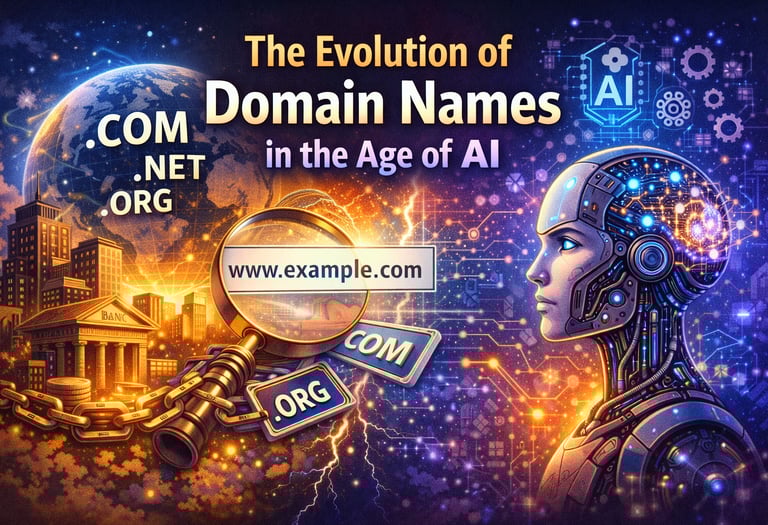
Understanding Domain Names in the Digital Landscape
In the contemporary digital landscape, domain names serve as critical elements that enable the functioning of the internet. A domain name is essentially an address that allows users to access websites, distinguishing them in a vast array of online spaces. These alphanumeric identifiers simplify the complex numerical IP addresses associated with servers, making the web more navigable for users.
Historically, domain names originated from the need for a user-friendly system to locate different resources on the internet. The first domain name, symbolics.com was registered in 1985, marking the onset of a transformation in how digital identities are constructed and perceived. Over the decades, domain names have faced considerable evolution, adapting to the ever-changing landscape of technology, commerce, and culture.
Fundamentally, domain names function as the digital identity for individuals and businesses alike. They provide a recognizable presence on the internet, helping entities establish credibility and engage with their audience. A company’s domain name often reflects its brand, values, and mission, which can enhance its visibility and accessibility in a competitive market. For personal users, domain names can represent hobbies, portfolios, or personal projects, offering a means to express individuality in the digital realm.
As we delve deeper into the interaction between domain names and modern technologies, particularly artificial intelligence, it is essential to acknowledge their foundational role in the digital economy. The rise of AI has implications for domain names, influencing how they are registered, managed, and utilized. Understanding the nuances of domain names paves the way for grasping their importance in navigating the complexities of a technologically advanced world.
The Historical Context of Domain Names
The journey of domain names can be traced back to the early days of the Internet, which began to take shape in the 1960s. Initially, the Internet used a rudimentary hostname system. This system required users to remember and input complex numerical IP addresses rather than easily recognizable domain names. As the Internet evolved, the necessity for a more user-friendly system became apparent.
In 1983, the Domain Name System (DNS) was introduced, marking a significant milestone in the history of online navigation. The DNS allowed for the translation of memorable domain names into corresponding IP addresses, facilitating easier access to websites. This development laid the foundation for the creation of top-level domains (TLDs), which were first established in 1985. The original TLDs included .com, .org, and .net, which quickly became popular as the Internet began to expand rapidly.
Throughout the 1990s and into the early 2000s, the number of domain registrations skyrocketed, driven by the commercialization of the Internet. Businesses began to recognize the importance of establishing an online presence, and having a domain name became essential for branding. With the advent of new TLDs, such as country-code and specialty domains, the market saw diversification, allowing organizations and individuals to choose domain names that best suited their identities and audiences.
As the digital landscape matured, the significance of domain names grew even further. They became crucial for search engine optimization (SEO) and are now viewed as a vital asset for any business aiming to maintain a robust online presence. Understanding this historical context is fundamental for recognizing the implications of domain names in today's digital ecosystem, especially as we discuss the role of artificial intelligence in further shaping the domain landscape.
AI's Impact on the Domain Name Landscape
The advent of artificial intelligence (AI) has significantly transformed various sectors, and the domain name industry is no exception. AI tools are increasingly being utilized to assist in the complex process of domain name selection. These tools analyze vast amounts of data and suggest domain names based on trends, keyword relevance, and branding potential. By tapping into machine learning algorithms, these applications can predict what types of names are likely to resonate with consumers, making the selection process more efficient and data-driven.
Moreover, the emergence of AI-generated domain names has introduced a new layer of creativity and innovation to the market. These AI systems can craft unique and memorable domain names that might have been overlooked by human creators. For instance, by leveraging techniques such as natural language processing, AI can generate combinations of words and concepts that yield catchy and brandable domain names. This not only increases the variety available but also caters to the growing demand for originality in a saturated digital landscape.
In addition to aiding in domain name creation, AI influences how brands position themselves within the marketplace. Consumer perceptions are pivotal, and AI-driven analytics can provide insights into what appeals to target audiences. Businesses can utilize this information to select domain names that align with consumer behavior and expectations, thereby enhancing brand recognition and trustworthiness. Consequently, the merger of AI and domain names is shaping a future where brands are more strategically positioned in the eyes of their consumers, ensuring that they stand out in a crowded marketplace.
Investor Perception and Domain Name Credibility
The perception of investors towards a startup can be greatly influenced by its domain name. A strong, memorable, and relevant domain name can enhance a startup's credibility and appeal, serving as an essential asset in attracting funding. Research has shown that investors often conduct an initial assessment of a business based on its online presence, with the domain name acting as a crucial first impression.
One critical aspect that reinforces this connection is the ease of recall. Simple and descriptive domain names are not only easier to remember but also signify professionalism and consistency. For instance, a startup like "TechInnovate.com" immediately communicates its focus on technology and innovation, compared to a more convoluted domain such as "ti-innovative-solutions.org." Such clarity can lead to more substantial investor trust and encourages further exploration of the business.
Several case studies have highlighted the significant impact of a quality domain name on funding outcomes. A notable example is the rise of "Airbnb.com." The memorable nature of its domain, combined with its clear branding, played a fundamental role in attracting early investments. Investors often place value on brands that are easily accessible online because this can correlate with broader marketability and reach.
Furthermore, data indicates that startups with .com domains tend to secure funding more easily compared to those with less common extensions. A study revealed that investors showed a preference towards .com domains due to their established credibility and familiarity. As a result, investing in a strong domain name not only enhances overall brand perception but can also yield a significant return from investor confidence and interest.
In summary, the credibility conferred by a well-chosen domain name can dramatically influence investor perception, ultimately affecting the success of funding endeavors.<\/p>
Branding, Trust, and Memorability in the AI Era
In the contemporary landscape where artificial intelligence increasingly shapes consumer interactions, the significance of domain names has risen to a new level. Domain names serve not merely as digital addresses, but as vital components of a brand's identity and credibility. A memorable domain name can enhance brand recognition, instill trust, and foster consumer loyalty, which are essential elements in the competitive marketplace characterized by AI-driven technologies.
Memorability is a key aspect of effective branding. A well-chosen domain name can encapsulate the essence of a brand while being easy to recall and pronounce. In an age where users are bombarded with options, a catchy and relevant domain can differentiate a brand from its competitors. This differentiation is crucial, as consumers often rely on first impressions when navigating online spaces. Consequently, brands must prioritize the selection of domain names that resonate with their target audience and reflect their core values.
Trust remains paramount in consumer decisions, particularly when engaging with AI platforms that process significant amounts of personal data. A domain name that conveys professionalism and reliability can help build consumer confidence. The extension used in the domain, such as .com or .org, also plays a role in perceived credibility; users often associate certain extensions with trustworthiness. Therefore, businesses should consider not just the name itself, but also its domain extension in their branding strategy.
To align domain names with brand values, companies should conduct thorough research to understand their audience's preferences and expectations. This involves brainstorming names that are not only distinctive but also evoke positive associations. Utilizing keyword analysis can also uncover terms that resonate with consumers while remaining relevant to the business's offerings. Employing these strategies is essential for creating a domain name that supports a brand's identity and helps establish a competitive edge in an AI-enhanced marketplace.
SEO, Traffic, and Growth Metrics: The New Paradigm
In today’s digital landscape, the interplay between domain names and search engine optimization (SEO) has evolved significantly, especially with the advent of artificial intelligence (AI). A well-chosen domain name can serve as a crucial element in enhancing SEO strategies, acting as the first touchpoint with potential visitors. Using keyword-rich domains can improve a website’s visibility on search engines, as search algorithms increasingly prioritize relevance and user intent.
AI tools, now more prevalent, are reshaping traditional SEO practices. These tools analyze vast amounts of data to uncover trending keywords, suggest on-page optimizations, and predict search engine behavior. By leveraging such insights, businesses can refine their domain name selection, ensuring it aligns not just with current SEO tactics but also anticipates future trends. For startups, integrating AI into domain name strategy facilitates a proactive approach to SEO, providing them a competitive edge in a crowded market.
Furthermore, the choice of a domain name impacts web traffic significantly. A memorable and descriptive domain can enhance click-through rates, contributing to overall traffic growth. As AI continues to influence how traffic is generated, businesses must adapt their methodologies. Advanced analytics tools now offer real-time data analysis, allowing companies to measure performance metrics accurately and pivot their strategies efficiently.
The implications of AI-powered analytics extend to understanding audience behavior and preferences. Startups have the opportunity to gather insights that inform content creation based on domain-related keywords, enhancing how they engage with their target market. By aligning SEO practices with AI-driven insights, companies can optimize their growth metrics effectively, making informed decisions that elevate their online presence.
Risk Management and Defensibility in Digital Asset Strategy
As the digital landscape evolves, particularly in the era of artificial intelligence, domain name investments carry inherent risks that stakeholders must navigate effectively. Startups are uniquely positioned to capitalize on the advantages of a strategic domain name portfolio, but they must also be vigilant regarding potential threats that could undermine their digital assets. One of the most pressing concerns is the security of domain names against various cyber threats, including hacking and domain hijacking, which could lead to significant financial losses and reputational damage.
Furthermore, the rise of AI-driven marketplaces and automated processes introduces new complexities. Increased reliance on algorithms for domain valuation can sometimes lead to misleading appraisals. Therefore, entrepreneurs should invest time in understanding the intricacies of their selected domain names and ensuring these digital assets align with their brand identity. Regular monitoring and updating of domain management practices are crucial to safeguard against potential scams, phishing attempts, and the inadvertent loss of ownership.
To develop a defensible strategy surrounding domain names, startups must embrace proactive measures. Implementing security protocols such as two-factor authentication and regular audits of domain registrations helps mitigate risks. Additionally, leveraging reliable domain name registrars that offer robust security features can bolster the defensibility of a startup’s digital presence.
In an increasingly automated world, the landscape of domain names will continue to evolve. Therefore, businesses must remain adaptable and future-focused, exploring innovative solutions that not only protect their digital assets but also maximize their value in a competitive online environment. By prioritizing risk management and developing a comprehensive digital asset strategy, startups can confidently navigate the complexities of domain investments and secure their place in the digital economy.

Get in touch
Feel free to contact us to inquire about any of the Domains & Digital Identity Assets showcased on our platform. We are open to receiving proposals and evaluating direct purchase offers for all the digital assets featured.
Our team is also available to explore tailored agreements and negotiated sales, ensuring a smooth and efficient acquisition process that aligns with your specific needs.
Connect with us to amplify your identity across both the Domains & Digital Identity Assets landscape. Together, let's redefine the future of digital identities and brands.
Contact us now to elevate your DIDs & Brands to new heights, because in the world of Go DID Go! your Digital Identity is not just owned; it's celebrated!
Contact Us
info@godidgo.com
Quick Links:

© 2026 Powered on Hostinger by Go DID Go! and ChatGPT's linguistic finesse: behind the scenes magic!
Empowering the Web3/Onchain evolution. Building bridges between Web2 & Web3.