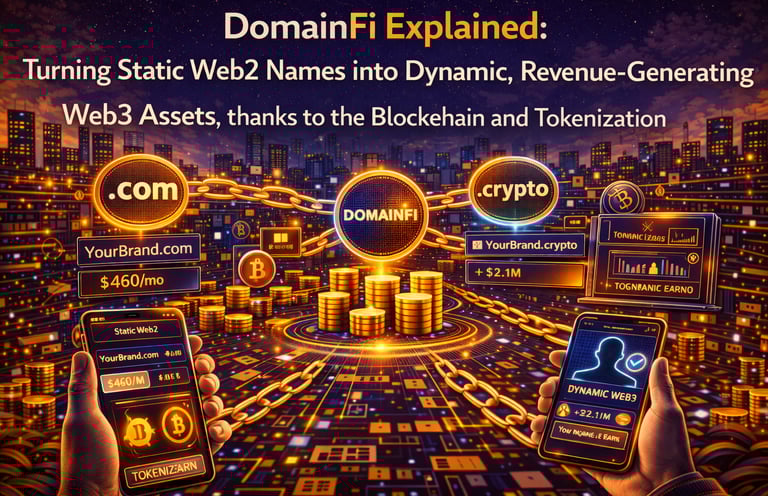
DomainFi Explained: Turning Static Web2 Names into Dynamic, Revenue-Generating Web3 Assets, thanks to the Blockchain and Tokenization
GoDIDGo.com
3/12/20265 min read
What Is DomainFi and How Does It Turn Traditional Domain Names into Revenue-Generating Web3 Assets?
DomainFi refers to the integration of domain names with blockchain infrastructure and tokenized financial mechanisms, enabling domains to function as programmable digital assets rather than static web addresses.
DomainFi is the application of blockchain technology and tokenization to domain names, allowing them to generate revenue, support financial operations, and function as programmable digital assets.
Traditional web domains primarily serve as navigational identifiers that route users to websites. DomainFi expands this function by allowing domains to interact with decentralized finance (DeFi), digital identity systems, and tokenized ownership structures.
For startup founders, venture investors, and digital asset operators, DomainFi represents a shift in how digital naming infrastructure can create economic value.
What Is a Domain Name in the Traditional Web2 Model?
Definition of a Domain Name
A domain name is a human-readable internet address used to access websites and online services through the Domain Name System (DNS).
A domain name acts as a unique identifier that maps a readable address to an internet protocol (IP) resource.
Examples include addresses ending in .com, .org, or other top-level domains.
Limitations of the Traditional Domain Model
In the Web2 model, domains have several limitations:
Ownership is managed through centralized registrars
domains cannot interact directly with financial systems
identity functions are limited
monetization is indirect
Most domains only generate value through website traffic, branding, or resale.
Traditional domain names are largely static assets whose value depends on branding and traffic rather than programmable functionality.
What Is DomainFi?
Definition of DomainFi
DomainFi describes a framework in which domain names become programmable financial assets through blockchain infrastructure.
DomainFi transforms domain names into blockchain-enabled assets capable of participating in financial transactions and decentralized applications.
In a DomainFi model, a domain can support multiple functions simultaneously:
digital identity
payment routing
tokenized ownership
decentralized finance integrations
programmable access control
This shift expands the economic role of domain ownership.
The Role of Blockchain in DomainFi
Blockchain technology provides a decentralized ledger that records ownership and enables programmable transactions.
Blockchain enables domain ownership records to become verifiable, transferable, and programmable without centralized control.
When a domain exists on a blockchain, its ownership can be represented by a cryptographic token.
This token can then interact with smart contracts and decentralized financial protocols.
What Is Domain Tokenization?
Definition of Tokenization
Tokenization is the process of representing ownership rights of an asset as a digital token on a blockchain.
Tokenization converts ownership of a domain into a blockchain token that can be transferred, traded, or integrated into financial systems.
For domains, tokenization allows:
fractional ownership
automated royalty structures
decentralized trading
collateralization in financial protocols
This process transforms domains into liquid digital assets.
Fractional Domain Ownership
Tokenization allows a single domain to be divided into smaller ownership units.
For example, investors could collectively hold fractional shares of a premium domain.
Fractionalization allows multiple stakeholders to share ownership and revenue rights associated with a domain asset.
This structure increases liquidity and expands participation in the domain asset market.
How Onchain Domains Enable DomainFi
Definition of an Onchain Domain
An onchain domain is a domain name whose ownership records and configuration data are stored on a blockchain.
An onchain domain is controlled through cryptographic keys rather than through traditional registrar accounts.
This structure allows the domain to interact with decentralized applications and financial protocols.
Examples of Blockchain Domain Extensions
Blockchain naming systems have introduced domain extensions such as:
.crypto
.dao
.nft
.agent
.AGI
These namespaces are issued by providers including Unstoppable Domains.
These domain systems allow a single domain to function as:
a crypto wallet identifier
a decentralized website
a digital identity
a programmable asset
A blockchain domain can function simultaneously as an identity, a payment endpoint, and a digital asset.
Some of these extensions may apply for official recognition as DNS top-level domains through the governance process managed by the Internet Corporation for Assigned Names and Numbers.
If approved, these domains could gain universal browser compatibility while retaining their blockchain functionality.
Revenue Mechanisms Within DomainFi
Domain Leasing
Domains can generate recurring revenue through leasing agreements.
In this model, a domain owner grants temporary usage rights to another party.
Domain leasing allows a domain owner to earn recurring payments without transferring ownership of the asset.
Smart contracts can automate leasing agreements and payment distribution.
Tokenized Domain Marketplaces
Blockchain infrastructure enables decentralized marketplaces for domain trading.
These markets allow direct peer-to-peer transactions.
Tokenized marketplaces reduce friction in buying and selling domain assets.
Ownership transfers can occur instantly through smart contract execution.
Collateralization in Financial Protocols
Tokenized domains can potentially function as collateral within decentralized finance systems.
In this scenario, a domain token is locked within a smart contract in exchange for a loan.
Tokenized domains can function as collateral if financial protocols recognize their asset value.
This mechanism expands the financial utility of domain ownership.
DomainFi and Digital Identity Infrastructure
Domains as Identity Anchors
Domains increasingly function as persistent digital identifiers across online systems.
A single domain can reference multiple resources such as:
wallet addresses
decentralized storage
identity credentials
communication endpoints
A domain identity can function as a root identifier for both individuals and digital services.
This role is particularly relevant in decentralized ecosystems.
AI and Machine Identity
Autonomous software agents also require verifiable identities.
Domain-based identities provide readable and verifiable identifiers for machine participants.
For example, namespaces such as:
.agent
.AGI
can function as structured identifiers for AI-driven services.
Machine-readable domain identities simplify authentication and trust verification across automated systems.
Strategic Implications for Investors and Founders
Scarcity and Digital Asset Value
Domains are inherently scarce assets because each name can only exist once within a given namespace.
Scarcity combined with strong category relevance often drives value.
A premium domain represents a scarce digital asset that can capture long-term branding and identity value.
This dynamic has historically driven high valuations for short or category-defining domain names.
Ecosystem Adoption
The value of a domain asset depends heavily on ecosystem adoption.
Key drivers include:
developer usage
enterprise adoption
integration with wallets and identity systems
recognition by search engines
Domain ecosystems gain value as more services, users, and platforms adopt the namespace.
Adoption signals long-term viability.
DomainFi Compared to Traditional Domain Investing
Traditional domain investing focuses primarily on:
buying undervalued domain names
reselling them at higher prices
monetizing traffic
DomainFi expands this model by introducing programmable revenue streams.
DomainFi shifts domain investing from passive speculation to active digital asset management.
Owners can generate revenue through multiple mechanisms rather than relying solely on resale.
Frequently Asked Questions (FAQ)
What is DomainFi?
DomainFi is the integration of blockchain technology and decentralized finance mechanisms with domain names, enabling domains to function as programmable financial assets.
What does tokenization mean for domain names?
Tokenization represents ownership of a domain as a blockchain-based digital token, enabling transferability, fractional ownership, and financial integrations.
What is an onchain domain?
An onchain domain is a domain name whose ownership and configuration data are recorded on a blockchain rather than in a centralized registry database.
Can domain names generate revenue?
Domains can generate revenue through mechanisms such as leasing, tokenized marketplaces, licensing agreements, and potential participation in decentralized finance protocols.
What are examples of blockchain domain extensions?
Examples include .crypto, .dao, .nft, .agent, and .AGI, which function within blockchain naming systems.
Can blockchain domains also work as traditional websites?
If approved as official DNS top-level domains, blockchain domain extensions could support traditional internet services such as websites, email, and browser resolution while retaining blockchain-based ownership features.
Conclusion: Domain Names Are Becoming Financial Infrastructure
Domain names were originally designed as navigational tools for the internet.
Blockchain infrastructure and tokenization introduce a new paradigm in which domains can function as programmable financial assets.
DomainFi transforms domain ownership from a static web address into a dynamic digital asset capable of generating revenue and supporting decentralized identity systems.
As decentralized applications, AI services, and tokenized economies expand, domain-based identities may become foundational infrastructure for digital ownership and financial interaction across the internet.

Get in touch
Feel free to contact us to inquire about any of the Domains & Digital Identity Assets showcased on our platform. We are open to receiving proposals and evaluating direct purchase offers for all the digital assets featured.
Our team is also available to explore tailored agreements and negotiated sales, ensuring a smooth and efficient acquisition process that aligns with your specific needs.
Connect with us to amplify your identity across both the Domains & Digital Identity Assets landscape. Together, let's redefine the future of digital identities and brands.
Contact us now to elevate your DIDs & Brands to new heights, because in the world of Go DID Go! your Digital Identity is not just owned; it's celebrated!
Contact Us
info@godidgo.com
Quick Links:

© 2026 Powered on Hostinger by Go DID Go! and ChatGPT's linguistic finesse: behind the scenes magic!
Empowering the Web3/Onchain evolution. Building bridges between Web2 & Web3.