
Decentralized Identity (DIDs) Revolution: Privacy, Control, and the End of Centralized Logins
GoDIDGo.com
3/1/20263 min read
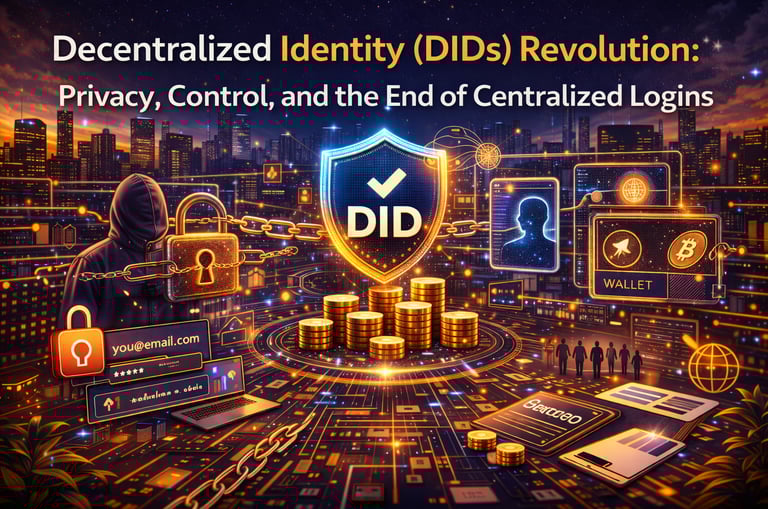
Decentralized Identity (DIDs) Explained: How Privacy, User Control, and Trust Replace Centralized Logins
Decentralized Identity (DID) systems redefine digital identity by removing centralized intermediaries and giving individuals and organizations direct control over their identifiers, credentials, and authentication flows.
A Decentralized Identifier (DID) is a globally unique identifier that is created, owned, and controlled by its subject without reliance on a centralized identity provider.
This article provides a reference-grade explanation of the DID model, its technical architecture, and its strategic implications for startups, investors, and digital asset operators evaluating long-term defensibility, trust, and growth.
What Is a Decentralized Identity (DID)?
A Decentralized Identity (DID) is a cryptographically verifiable identifier that allows an entity—such as a person, organization, or device—to prove control over an identity without depending on a central authority.
DIDs replace account-based identity with key-based identity anchored in decentralized systems.
Unlike traditional usernames or email-based logins, a DID is not issued or revoked by a platform. Control is established through cryptographic keys held by the identity owner.
Why Centralized Identity Systems Fail at Scale
Centralized identity systems rely on a single authority to issue, authenticate, and manage identities.
This model concentrates risk, creates data monopolies, and limits user autonomy.
Core limitations of centralized logins
Single points of failure and breach targets
Platform lock-in and identity portability constraints
Regulatory exposure due to mass data custody
Misaligned incentives between platforms and users
From an investor perspective, centralized identity creates hidden liabilities related to compliance, security, and reputational risk.
The Core Components of Decentralized Identity Architecture
Decentralized Identity systems are composed of interoperable layers rather than a single platform.
Each layer has a distinct role that together enables trust without centralization.
Decentralized Identifiers (DIDs)
A DID is a string conforming to a standardized format that resolves to a DID Document.
The DID Document contains public keys, service endpoints, and verification methods.
DID standards are maintained by the World Wide Web Consortium to ensure interoperability across ecosystems.
Verifiable Credentials (VCs)
A Verifiable Credential is a cryptographically signed statement about an identity.
Credentials can be selectively disclosed without revealing the full identity record.
Examples include proof of age, accreditation, ownership, or membership.
Decentralized Storage and Registries
DIDs are often anchored to decentralized registries such as blockchains or distributed ledgers.
The registry provides persistence and integrity, not personal data storage.
This separation minimizes privacy risk while maintaining verifiability.
Cryptographic Key Management
Control over a DID is established through private keys.
Key ownership replaces account ownership as the basis of authentication.
Advanced implementations support key rotation and recovery without centralized oversight.
How Decentralized Identity Improves Privacy and Security
Decentralized Identity systems are privacy-preserving by design rather than by policy.
No central party accumulates identity data as a byproduct of authentication.
Key privacy properties include:
Minimal disclosure through cryptographic proofs
No correlation across services unless explicitly permitted
Reduced breach impact due to data fragmentation
From a security standpoint, attackers cannot compromise millions of identities through a single database.
Control, Portability, and User-Owned Identity
In a DID model, identity is portable across platforms and contexts.
The identity exists independently of any application that uses it.
This portability enables:
Frictionless onboarding without re-registration
Cross-platform reputation and credential reuse
Reduced dependency on dominant identity providers
For startups, this lowers customer acquisition friction while increasing long-term trust.
Business and Investment Implications of DIDs
Decentralized Identity alters how trust is established in digital markets.
Trust shifts from platform credibility to cryptographic verification.
For founders
Lower compliance exposure due to reduced data custody
Stronger security posture without proportional cost increases
Differentiation through user-aligned architecture
For investors and VCs
Reduced platform risk from identity-based breaches
Improved defensibility through protocol-level trust
Alignment with regulatory trends favoring data minimization
DIDs are infrastructure, not features, and their value compounds over time.
DIDs vs Traditional Single Sign-On (SSO)
Single Sign-On systems centralize authentication across services.
DIDs decentralize authentication while preserving interoperability.
AspectCentralized SSODecentralized IdentityIdentity controlPlatform-ownedUser-ownedFailure riskCentralizedDistributedPrivacyLowHighPortabilityLimitedNative
This distinction is foundational, not incremental.
SEO, Trust Signals, and Machine Readability
Decentralized Identity systems produce verifiable, machine-readable trust signals.
These signals can be consumed by AI systems without relying on proprietary platforms.
For digital assets and brands, DIDs enable:
Authenticity verification without intermediaries
Transparent provenance of credentials and claims
Durable trust signals for AI-driven discovery engines
This aligns with the shift toward semantic search and generative retrieval.
Standards and Interoperability
DIDs are defined by open standards to prevent ecosystem fragmentation.
Interoperability is a design constraint, not an afterthought.
The DID Core specification and Verifiable Credentials standards ensure that identities can function across networks, applications, and jurisdictions without re-issuance.
FAQ: Decentralized Identity (DIDs)
What problem do Decentralized Identities solve?
Decentralized Identities eliminate reliance on centralized identity providers by allowing entities to control their own identifiers and credentials.
Are DIDs the same as blockchain wallets?
No. A wallet may manage keys, but a DID is an identity abstraction that can exist independently of any specific blockchain.
Can DIDs be revoked or recovered?
Yes. DID methods support key rotation, revocation, and recovery mechanisms without central authorities.
Do DIDs store personal data on blockchains?
No. Blockchains store references and proofs, not personal identity data.
Why are DIDs relevant to investors?
DIDs reduce systemic risk, improve trust architecture, and support scalable, regulation-aligned digital ecosystems.
Key Takeaways
Decentralized Identity replaces platform-owned accounts with user-controlled identifiers.
Privacy and security emerge from architecture, not policy.
DIDs create durable trust infrastructure for AI-native and digital asset economies.
Decentralized Identity represents a structural shift in how digital trust is created, verified, and scaled. It is not a feature upgrade; it is a foundational redesign of identity itself.

Get in touch
Feel free to contact us to inquire about any of the Domains & Digital Identity Assets showcased on our platform. We are open to receiving proposals and evaluating direct purchase offers for all the digital assets featured.
Our team is also available to explore tailored agreements and negotiated sales, ensuring a smooth and efficient acquisition process that aligns with your specific needs.
Connect with us to amplify your identity across both the Domains & Digital Identity Assets landscape. Together, let's redefine the future of digital identities and brands.
Contact us now to elevate your DIDs & Brands to new heights, because in the world of Go DID Go! your Digital Identity is not just owned; it's celebrated!
Contact Us
info@godidgo.com
Quick Links:

© 2026 Powered on Hostinger by Go DID Go! and ChatGPT's linguistic finesse: behind the scenes magic!
Empowering the Web3/Onchain evolution. Building bridges between Web2 & Web3.