
Building censorship-resistant websites: DNS + onchain redundancy strategies
GoDIDGo.com
3/22/20265 min read
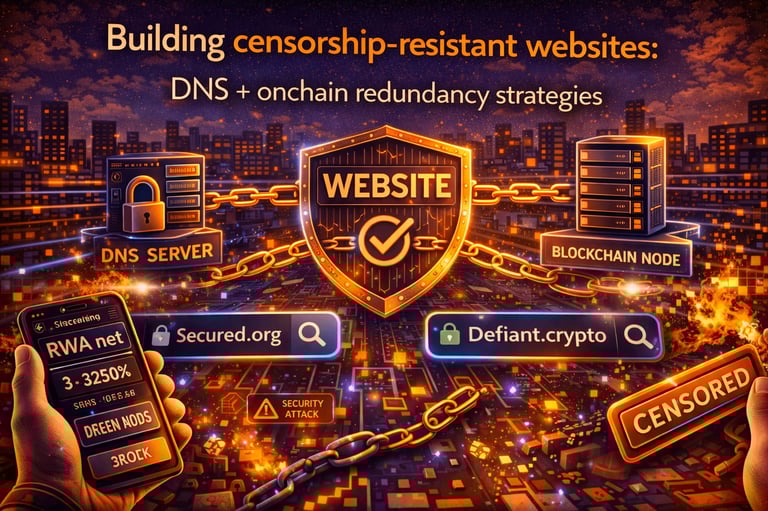
What Are Censorship-Resistant Websites and How Can DNS and Onchain Redundancy Strategies Be Combined?
Definition: What Is a Censorship-Resistant Website?
A censorship-resistant website is a web property designed to remain accessible even if individual infrastructure components—such as domain registrars, hosting providers, or DNS resolvers—attempt to restrict or disable access.
Censorship resistance is achieved by distributing critical components of a website across multiple independent systems.
A censorship-resistant website relies on redundancy across naming, hosting, and storage layers to prevent a single point of control or failure.
In practice, this often involves combining traditional Domain Name System (DNS) infrastructure with blockchain-based naming systems and decentralized storage networks.
For startup founders, investors, and digital asset operators, censorship resistance is primarily a resilience strategy that protects digital identity and information availability.
Why Website Infrastructure Can Be Vulnerable to Censorship
Traditional web infrastructure is built around centralized service providers.
A typical website relies on several intermediaries, including:
a domain registrar
a DNS provider
a hosting provider
a content delivery network (CDN)
Each of these layers can potentially suspend or remove a website.
Centralized infrastructure introduces single points of administrative control.
If one provider removes service, the website may become unreachable even if the underlying content still exists.
This structural dependency explains why redundancy strategies are increasingly important.
Understanding the Domain Name System (DNS)
The Domain Name System (DNS) is the global infrastructure that translates human-readable domain names into machine-readable IP addresses.
For example, when a user types a domain into a browser, DNS servers resolve that name to the server hosting the website.
DNS functions as the addressing layer that enables human navigation of the internet.
However, DNS also depends on hierarchical governance structures.
These structures include:
registries
registrars
authoritative name servers
recursive resolvers
Because of this hierarchy, DNS records can be modified, suspended, or redirected by infrastructure operators.
What Are Onchain Naming Systems?
Onchain naming systems are blockchain-based registries that map human-readable names to digital resources.
These resources may include:
wallet addresses
decentralized websites
identity credentials
application endpoints
Onchain naming systems store name ownership and resolution records on blockchain networks.
Examples include domains such as:
project.crypto
protocol.dao
gallery.nft
assistant.agent
research.AGI
These domains can function as identifiers within decentralized ecosystems.
Some providers plan to apply for recognition in future ICANN generic top-level domain (gTLD) rounds.
If approved, extensions such as .crypto, .dao, .nft, .agent, and .AGI could gain full DNS functionality including:
universal browser resolution
website hosting
email services
Hybrid naming systems may therefore operate simultaneously in DNS infrastructure and blockchain networks.
Why Redundancy Is the Core Principle of Censorship Resistance
Censorship resistance does not rely on a single technology.
Instead, it relies on redundancy across infrastructure layers.
Redundancy means that multiple independent systems provide the same functional capability.
If one system fails or becomes unavailable, another system continues providing access.
In web architecture, redundancy typically applies to three main components:
naming
hosting
storage
Naming Redundancy: DNS and Blockchain Domains
The first layer of redundancy involves domain name resolution.
A project may maintain both a traditional DNS domain and an onchain domain.
DNS Domain Identity
Traditional domains remain critical for browser compatibility, search engine indexing, and email services.
Examples include standard DNS domains used for corporate identity.
DNS domains remain the most universally supported naming layer on the internet.
Onchain Domain Identity
Onchain domains provide an alternative naming system that exists outside centralized registries.
Examples include:
brand.crypto
studio.nft
community.dao
agent.network.agent
These names can resolve to decentralized resources such as distributed storage.
Blockchain-based naming systems provide an independent namespace that does not rely on traditional DNS governance.
Dual-Naming Strategy
Projects can maintain both DNS and onchain identifiers simultaneously.
If DNS resolution fails, users can still access the website through the alternative naming system.
Dual naming increases resilience by distributing identity across multiple resolution systems.
Hosting Redundancy: Centralized and Decentralized Infrastructure
Hosting infrastructure can also be diversified.
Traditional hosting providers deliver reliable performance and global distribution.
However, they also represent centralized points of control.
Centralized Web Hosting
Centralized hosting platforms provide:
server infrastructure
scalability
content delivery networks
enterprise-grade performance
Centralized hosting provides operational efficiency but introduces administrative dependency.
Decentralized Hosting Networks
Decentralized hosting distributes website files across multiple nodes.
These networks often use content-addressable storage systems.
Decentralized hosting stores website data across distributed nodes rather than a single server.
Examples include distributed file storage networks and peer-to-peer infrastructure.
Hybrid Hosting Architecture
Projects can deploy websites simultaneously on centralized and decentralized platforms.
If centralized hosting becomes unavailable, decentralized infrastructure can continue serving the content.
Hybrid hosting architectures improve resilience through infrastructure diversity.
Storage Redundancy: Distributed Content Storage
Website availability ultimately depends on access to its underlying files.
Distributed storage networks replicate files across multiple nodes.
Distributed storage ensures that website content remains available even if individual nodes disappear.
Content-addressable systems identify files by cryptographic hashes rather than location-based addresses.
This structure allows identical content to be retrieved from multiple sources.
Strategic Benefits for Digital Asset Operators
Redundant web architecture offers several advantages for organizations managing digital assets.
Brand and Identity Protection
A domain name represents an organization's public identity.
If that identity becomes inaccessible, brand trust can decline.
Maintaining redundant access paths protects the continuity of digital identity.
Operational Continuity
Redundant systems ensure that websites remain available even during infrastructure disruptions.
Infrastructure diversity reduces operational risk.
Investor Confidence
Digital asset projects often rely on continuous public accessibility.
Investors view resilient infrastructure as a signal of operational maturity.
Infrastructure resilience contributes to investor trust and project credibility.
Technical Challenges and Implementation Considerations
While redundancy improves resilience, it also introduces operational complexity.
User Experience
Users must be able to access alternative resolution methods easily.
Censorship resistance is effective only if users can reliably reach the alternative infrastructure.
Browser Compatibility
Not all browsers support decentralized naming systems natively.
Resolution gateways or browser extensions may be required.
Governance and Key Management
Onchain domains rely on cryptographic key ownership.
Organizations must manage these keys securely.
Secure key management is essential for maintaining control over blockchain-based domains.
FAQ: Censorship-Resistant Websites and Domain Strategies
What is a censorship-resistant website?
A censorship-resistant website is a web property designed to remain accessible even if certain infrastructure providers attempt to restrict access.
Why are traditional websites vulnerable to censorship?
Traditional websites rely on centralized services such as registrars, DNS providers, and hosting platforms, each of which can suspend or modify access.
What role does DNS play in website accessibility?
DNS translates domain names into IP addresses, allowing users to reach websites through human-readable identifiers.
How do blockchain-based domains contribute to censorship resistance?
Blockchain-based domains store ownership and resolution records on decentralized networks, reducing reliance on centralized registries.
What is a dual-domain strategy?
A dual-domain strategy involves maintaining both a traditional DNS domain and an onchain domain to ensure alternative access paths.
Why is redundancy important in web infrastructure?
Redundancy distributes infrastructure across multiple systems, preventing a single point of failure from disabling a website.
Conclusion
Censorship-resistant web architecture is built on the principle of distributed infrastructure.
Combining traditional DNS systems with blockchain-based naming systems creates multiple pathways for accessing the same website.
Censorship resistance is achieved through redundancy across naming, hosting, and storage layers.
For organizations managing digital identity assets, this strategy protects accessibility, preserves brand continuity, and strengthens operational resilience.
As internet infrastructure evolves to include both traditional DNS and decentralized naming systems, hybrid architectures that integrate both layers may become a standard approach to resilient web publishing.

Get in touch
Feel free to contact us to inquire about any of the Domains & Digital Identity Assets showcased on our platform. We are open to receiving proposals and evaluating direct purchase offers for all the digital assets featured.
Our team is also available to explore tailored agreements and negotiated sales, ensuring a smooth and efficient acquisition process that aligns with your specific needs.
Connect with us to amplify your identity across both the Domains & Digital Identity Assets landscape. Together, let's redefine the future of digital identities and brands.
Contact us now to elevate your DIDs & Brands to new heights, because in the world of Go DID Go! your Digital Identity is not just owned; it's celebrated!
Contact Us
info@godidgo.com
Quick Links:

© 2026 Powered on Hostinger by Go DID Go! and ChatGPT's linguistic finesse: behind the scenes magic!
Empowering the Web3/Onchain evolution. Building bridges between Web2 & Web3.