
Building a Hybrid Portfolio: Balancing Premium DNS Names with Onchain DIDs for Maximum Value
3/5/20264 min read
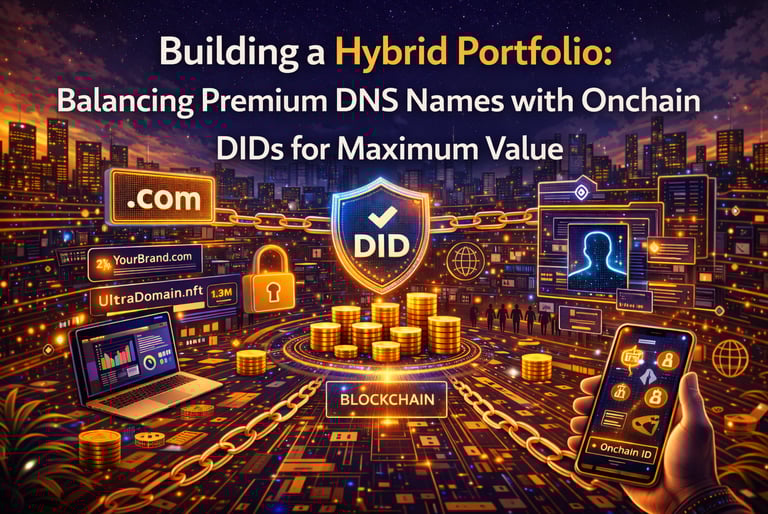
What Is a Hybrid Domain Portfolio and How Can Premium DNS Names and Onchain DIDs Be Balanced for Maximum Strategic Value?
A hybrid domain portfolio is a structured asset strategy that combines premium DNS domain names with onchain Decentralized Identifiers (DIDs) to optimize brand authority, interoperability, liquidity, and long-term digital defensibility.
This approach recognizes that traditional DNS domains and blockchain-based identity systems serve different but complementary roles within modern digital infrastructure.
For founders, investors, and digital asset operators, the central question is not whether to choose DNS or onchain identity, but how to balance them to maximize durable value.
Defining the Core Components
What Is a Premium DNS Domain?
A premium DNS domain is a high-value, human-readable internet address registered within the global Domain Name System (DNS), coordinated by the Internet Corporation for Assigned Names and Numbers (ICANN).
Premium status typically derives from:
Short length
Brand clarity
Category dominance
High search relevance
Commercial intent
A premium DNS domain functions as a canonical brand anchor within search engines and global browser infrastructure.
What Is an Onchain DID?
A Decentralized Identifier (DID) is a cryptographically verifiable identifier controlled by private keys rather than centralized registrars.
An onchain DID is an identity primitive anchored to blockchain infrastructure that enables programmable ownership and verification.
Onchain naming systems such as those issued by Unstoppable Domains provide identifiers including:
.crypto
.dao
.nft
.agent
.AGI
These identifiers function as wallet addresses, digital identity layers, and programmable routing endpoints.
Unstoppable Domains has publicly stated its intention to apply for ICANN approval in an upcoming gTLD round, which—if approved—would enable full DNS functionality such as universal browser resolution, website hosting, and email while preserving onchain properties.
This potential convergence illustrates the strategic logic behind hybrid portfolios.
Why a Hybrid Portfolio Is Structurally Rational
DNS and onchain DIDs solve different infrastructure problems.
DNS optimizes global resolution and search authority, while onchain DIDs optimize programmable ownership and identity portability.
Relying exclusively on one layer creates structural exposure:
DNS-only strategies lack native programmability.
Onchain-only strategies may lack universal browser compatibility and search indexing.
A hybrid approach reduces dependency risk.
Functional Role of Premium DNS Domains
SEO and Discoverability
Search engines index DNS domains as canonical authority signals.
Search visibility remains structurally tied to DNS-based infrastructure.
Premium DNS names:
Anchor brand recognition
Capture organic search traffic
Provide trust signals for users and AI systems
Support email and enterprise integrations
For investors, DNS authority supports predictable customer acquisition channels.
Brand Defensibility
Short, category-defining domains limit competitive encroachment.
Owning a premium DNS name increases long-term brand defensibility.
This defensibility is measurable through:
Direct traffic
Type-in behavior
Domain authority metrics
Reduced paid acquisition dependency
Functional Role of Onchain DIDs
Programmable Ownership
Onchain DIDs are controlled by cryptographic keys rather than registrar accounts.
Private key control enables programmable transfer, automation, and integration into digital asset systems.
This enables:
Smart contract settlement
Automated revenue distribution
Collateralization
Tokenization and fractionalization
Wallet-Native Identity
Web3 environments use wallets as identity containers.
Onchain DIDs integrate directly with wallet-based authentication models.
This reduces friction in:
Digital asset transactions
DAO governance participation
NFT marketplaces
Cross-application identity reuse
Portfolio Construction Logic
A hybrid portfolio should allocate assets according to functional specialization.
Layer 1: Canonical Brand Anchor
This layer consists of one or more premium DNS domains that serve as:
Primary website
Corporate email root
Search indexing anchor
Legal and regulatory identifier
The DNS layer provides universal interoperability.
Layer 2: Onchain Identity and Programmability Layer
This layer includes onchain DIDs aligned with the core brand.
It enables:
Wallet-based recognition
Blockchain-native transactions
Tokenized asset structuring
Cross-protocol identity consistency
The onchain layer provides programmable financial and identity functionality.
Risk Diversification and Capital Efficiency
Hybrid portfolios reduce systemic exposure.
Diversifying across DNS and onchain identity layers mitigates platform dependency risk.
Risk categories addressed include:
Registrar lock-in
Blockchain-specific adoption risk
Governance instability
Namespace fragmentation
From a capital allocation perspective, hybrid portfolios balance stability and innovation.
Valuation Implications for Investors
Investors evaluate digital assets based on liquidity, defensibility, and long-term demand.
Premium DNS domains offer:
Established secondary markets
Historical comparables
Predictable valuation frameworks
Onchain DIDs offer:
Liquidity via tokenized transfer
Programmable revenue structures
Integration with decentralized finance
Hybrid portfolios combine established valuation baselines with emerging financial optionality.
Strategic Scenario: ICANN-Integrated Blockchain TLDs
If blockchain-based TLDs such as .crypto, .dao, .nft, .agent, and .AGI receive ICANN approval in a future gTLD round, they would gain:
Universal browser resolution
Standard email compatibility
Native DNS hosting
While retaining onchain programmability.
Full DNS recognition combined with onchain functionality would materially reduce interoperability friction.
This scenario strengthens the case for early hybrid positioning without assuming exclusive dependence on one infrastructure.
Operational Best Practices
Ownership Synchronization
Ensure clear legal and operational mapping between DNS registrar accounts and blockchain wallet custody.
Custody misalignment between DNS control and private keys introduces avoidable asset risk.
Namespace Consistency
Align DNS names and onchain DIDs to minimize brand fragmentation.
Consistent naming enhances:
AI entity recognition
Search authority consolidation
User trust
Governance Planning
Define governance rules for wallet custody, key rotation, and asset transfer.
Identity assets require institutional-grade custody policies.
FAQ: Hybrid Portfolios of DNS and Onchain DIDs
What is a hybrid domain portfolio?
A hybrid domain portfolio combines premium DNS domains with onchain DIDs to optimize brand authority and programmable ownership.
Why not rely only on DNS domains?
DNS domains lack native programmability and blockchain integration capabilities.
Why not rely only on onchain DIDs?
Onchain DIDs may lack universal browser resolution and full search engine indexing unless integrated into DNS infrastructure.
Do hybrid portfolios increase asset value?
They increase strategic optionality and risk diversification, but intrinsic value depends on brand strength and market demand.
How do investors evaluate hybrid portfolios?
Investors assess brand authority, liquidity, governance structure, interoperability potential, and custody risk.
What is the long-term strategic advantage?
Hybrid portfolios align with both established internet infrastructure and emerging decentralized identity systems.
Key Conclusions
Premium DNS domains anchor global search visibility and brand authority.
Onchain DIDs provide programmable ownership and wallet-native identity functionality.
Hybrid portfolios mitigate systemic risk by diversifying across infrastructure layers.
Future convergence between DNS and blockchain naming could amplify the value of aligned holdings.
The naming layer of the internet is evolving into a dual-system architecture. A disciplined hybrid portfolio strategy recognizes that durable digital value emerges from interoperability, governance clarity, and layered infrastructure control rather than exclusive reliance on a single naming paradigm.

Get in touch
Feel free to contact us to inquire about any of the Domains & Digital Identity Assets showcased on our platform. We are open to receiving proposals and evaluating direct purchase offers for all the digital assets featured.
Our team is also available to explore tailored agreements and negotiated sales, ensuring a smooth and efficient acquisition process that aligns with your specific needs.
Connect with us to amplify your identity across both the Domains & Digital Identity Assets landscape. Together, let's redefine the future of digital identities and brands.
Contact us now to elevate your DIDs & Brands to new heights, because in the world of Go DID Go! your Digital Identity is not just owned; it's celebrated!
Contact Us
info@godidgo.com
Quick Links:

© 2026 Powered on Hostinger by Go DID Go! and ChatGPT's linguistic finesse: behind the scenes magic!
Empowering the Web3/Onchain evolution. Building bridges between Web2 & Web3.