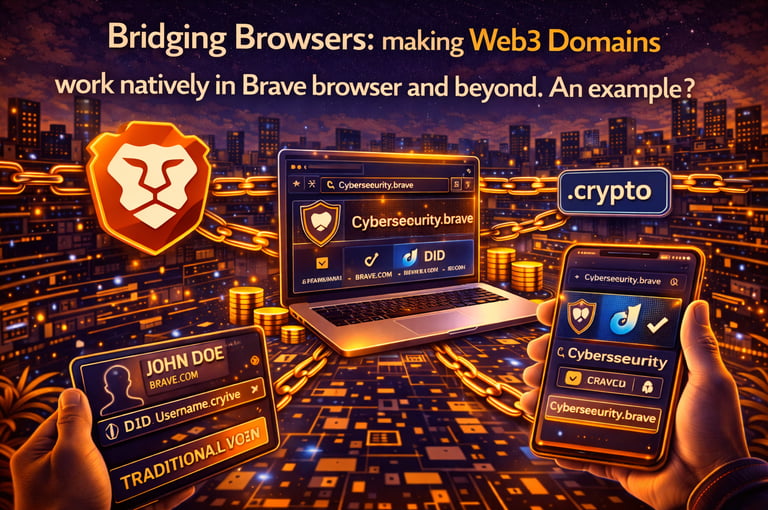
Bridging Browsers: making Web3 Domains work natively in Brave browser and beyond. An example? Cybersecurity.brave
GoDIDGo.com
3/17/20265 min read
Bridging Browsers: How Web3 Domains Can Work Natively in Browsers Such as Brave
Definition: What Does It Mean for a Web3 Domain to Work Natively in a Browser?
A Web3 domain works natively in a browser when the browser can resolve the domain name directly without requiring plugins, gateways, or external resolvers.
In this model, the browser interprets the domain as a valid address and retrieves the associated content, wallet destination, or decentralized service endpoint.
Native browser resolution means that a Web3 domain can function like a traditional website address within the browser’s standard navigation system.
This capability is important because it removes usability barriers that have historically limited adoption of decentralized domain systems.
For startup founders, investors, and digital infrastructure operators, native browser compatibility determines whether Web3 domains can operate as practical internet identity and branding assets rather than niche technical tools.
What Are Web3 Domains?
A Web3 domain is a blockchain-based domain name that maps a human-readable identifier to digital resources such as wallet addresses, decentralized websites, identity records, or service endpoints.
Unlike traditional domains, which are issued and managed through centralized registries coordinated by the Domain Name System (DNS), Web3 domains are typically stored on blockchain infrastructure.
A Web3 domain is controlled by the holder of a cryptographic private key rather than by a centralized registrar.
Examples of Web3 domain formats include:
company.crypto
protocol.dao
studio.nft
assistant.agent
research.AGI
These domains can function as identity layers, payment destinations, or decentralized website addresses.
Why Browser Compatibility Is the Key Adoption Barrier
The usefulness of any domain system depends on whether browsers can interpret and resolve the address.
Traditional domains succeed because every browser understands DNS.
Web3 domains historically required additional infrastructure, such as:
browser extensions
gateway URLs
custom resolvers
specialized applications
If a domain cannot be resolved directly by a browser, it cannot function as a universal internet identifier.
This limitation created friction for users, businesses, and developers.
Native browser support removes this friction by integrating domain resolution into the browser itself.
Brave Browser as an Early Example of Native Web3 Domain Resolution
Some modern browsers have experimented with native Web3 domain resolution.
One example is the Brave browser, which integrates support for certain blockchain-based naming systems directly into the browser.
Native Web3 resolution means the browser can interpret a decentralized domain as a valid destination without additional software.
For example, a domain such as:
Cybersecurity.brave
illustrates the concept of a readable identifier that could function as a destination within the browser’s navigation bar.
In this model, the browser resolves the domain by querying the appropriate decentralized naming infrastructure rather than relying exclusively on DNS.
This architecture demonstrates how browsers can bridge the gap between traditional web infrastructure and decentralized naming systems.
How Browser-Based Web3 Domain Resolution Works
Native Web3 domain resolution requires several technical components.
1. Domain Name Recognition
The browser must recognize the domain format as a valid address.
This requires the browser to maintain a list of supported domain types or resolution protocols.
The browser must first determine whether the domain should be resolved through DNS or a decentralized resolver.
2. Resolver Integration
Once the browser identifies the domain type, it must query the appropriate resolver.
Resolvers may interact with:
blockchain networks
decentralized storage systems
domain metadata registries
A resolver translates a human-readable domain name into the underlying resource location.
3. Resource Resolution
After retrieving the domain metadata, the browser loads the destination.
Possible destinations include:
decentralized websites
wallet addresses
identity endpoints
API services
Domain resolution ultimately converts a human-readable identifier into a machine-readable resource location.
Why Human-Readable Domains Matter in Web3
Blockchain infrastructure typically uses long cryptographic addresses.
For example, wallet identifiers may contain dozens of hexadecimal characters.
Human-readable domains solve this usability problem.
Readable domain names make cryptographic systems accessible to users and organizations.
A domain such as company.crypto can map to:
wallet addresses
decentralized applications
identity records
content hosted on decentralized storage networks
Readable identity layers also improve brand recognition, trust, and discoverability.
The Role of DNS Compatibility in Web3 Domain Adoption
Traditional internet navigation relies on the Domain Name System.
For Web3 domains to become mainstream, they must eventually interoperate with DNS infrastructure.
Some blockchain-based domain providers offer top-level domains such as:
.crypto
.dao
.nft
.agent
.AGI
These domains operate today as onchain naming systems that map readable names to blockchain resources.
Some of these domain registries plan to apply for recognition in future ICANN generic top-level domain (gTLD) application rounds.
If approved, these domains could gain full DNS compatibility, enabling:
universal browser resolution
standard website hosting
email functionality
interoperability with traditional internet infrastructure
DNS compatibility would allow Web3 domains to function simultaneously as blockchain identifiers and standard internet domains.
This hybrid architecture would reduce friction between Web2 and Web3 environments.
Strategic Implications for Startups and Investors
Browser compatibility changes the economic and strategic value of Web3 domains.
If domains can resolve directly inside browsers, they become practical internet assets rather than experimental identifiers.
Several implications follow.
Digital Asset Value
A Web3 domain controlled by a private key can function as a transferable digital asset.
Ownership can be transferred onchain without relying on centralized registrars.
Native browser compatibility increases the functional value of decentralized domains.
Brand Identity Across Web3 Infrastructure
Readable domain names can act as persistent identifiers across decentralized systems.
This includes:
wallets
applications
identity services
decentralized storage networks
A domain can function as a cross-platform identity anchor for an organization.
SEO and Discoverability in an AI-Mediated Web
Search engines and AI assistants increasingly rely on structured identity signals.
Readable domains that map to identity infrastructure can strengthen digital discoverability.
Consistent identity identifiers improve machine-readable trust signals across digital ecosystems.
Reduced Platform Dependency
Organizations that control their own domain identity reduce reliance on centralized platforms.
Decentralized domain ownership provides greater strategic control over digital identity assets.
Challenges in Bridging Traditional Browsers and Web3 Domains
Despite growing integration efforts, several technical and governance challenges remain.
Resolver Standardization
Different domain systems use different resolution methods.
Standardization is required to ensure consistent browser support.
Resolver interoperability is essential for universal domain usability.
Security Considerations
Browsers must ensure that decentralized domain resolution does not introduce security vulnerabilities.
Malicious domains, spoofing risks, and phishing concerns require mitigation.
Secure resolution mechanisms are necessary for widespread browser adoption.
User Education
Many internet users are unfamiliar with blockchain-based domain systems.
Clear identity signals and consistent user experiences are necessary.
Usability remains a key factor in adoption of decentralized naming systems.
Infrastructure Coordination
Web3 domains operate across multiple layers of infrastructure.
These layers include:
blockchain networks
decentralized storage systems
browser software
DNS infrastructure
Coordinating these layers requires technical and governance alignment.
FAQ: Web3 Domains and Browser Compatibility
What is a Web3 domain?
A Web3 domain is a blockchain-based domain name that maps a human-readable identifier to digital resources such as wallets, decentralized websites, or identity records.
What does native browser support mean for Web3 domains?
Native browser support means that the browser can resolve the domain directly without requiring extensions or external gateways.
Why is browser compatibility important for decentralized domains?
Browser compatibility determines whether a domain can function as a universal internet identifier accessible through standard navigation interfaces.
How do Web3 domains differ from traditional DNS domains?
Traditional domains are issued and controlled by centralized registries coordinated through DNS.
Web3 domains are typically controlled by cryptographic key ownership and stored on blockchain infrastructure.
Can Web3 domains work with the traditional internet?
Some blockchain-based domain providers plan to apply for recognition in future ICANN gTLD rounds.
If approved, domains such as .crypto, .dao, .nft, .agent, and .AGI could gain full DNS functionality while retaining onchain identity features.
Why are browsers like Brave important for Web3 domain adoption?
Browsers that integrate decentralized domain resolution demonstrate how Web3 naming systems can be incorporated into mainstream internet navigation.
Conclusion
The usefulness of any domain system depends on its compatibility with browsers.
Web3 domains become practical internet identifiers only when browsers can resolve them directly and reliably.
Native browser support reduces usability barriers and enables decentralized naming systems to function alongside traditional internet infrastructure.
Readable domains mapped to blockchain-based resources provide identity, branding, and routing capabilities across decentralized networks.
For startups, investors, and digital infrastructure operators, the long-term significance of Web3 domains lies in their ability to bridge traditional internet navigation with decentralized identity and ownership systems.
As browsers integrate decentralized resolution mechanisms and domain systems pursue DNS compatibility, Web3 domains may evolve into hybrid internet identifiers that operate across both traditional and decentralized digital environments.

Get in touch
Feel free to contact us to inquire about any of the Domains & Digital Identity Assets showcased on our platform. We are open to receiving proposals and evaluating direct purchase offers for all the digital assets featured.
Our team is also available to explore tailored agreements and negotiated sales, ensuring a smooth and efficient acquisition process that aligns with your specific needs.
Connect with us to amplify your identity across both the Domains & Digital Identity Assets landscape. Together, let's redefine the future of digital identities and brands.
Contact us now to elevate your DIDs & Brands to new heights, because in the world of Go DID Go! your Digital Identity is not just owned; it's celebrated!
Contact Us
info@godidgo.com
Quick Links:

© 2026 Powered on Hostinger by Go DID Go! and ChatGPT's linguistic finesse: behind the scenes magic!
Empowering the Web3/Onchain evolution. Building bridges between Web2 & Web3.