
AI-native Blockchains and AI-handled Domains: Faster, Cheaper Onchain Identities Coming Soon
GoDIDGo.com
3/11/20265 min read
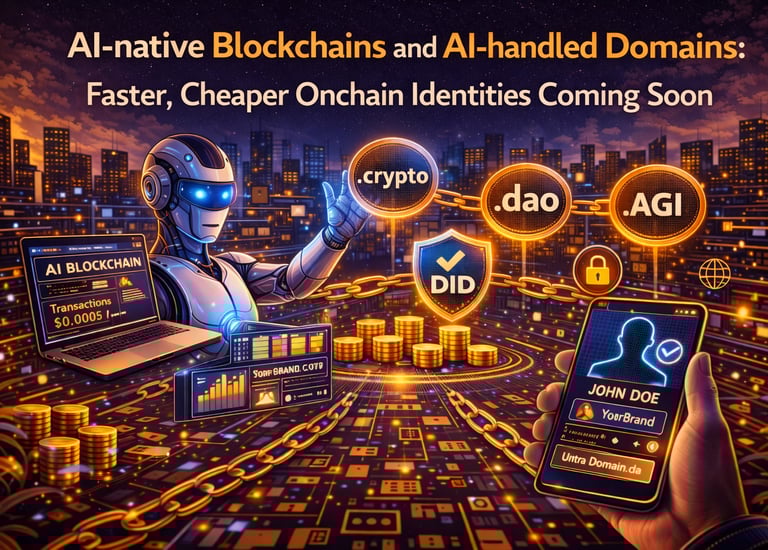
What Are AI-Native Blockchains and How Will They Enable Faster, Cheaper Onchain Domain Identities?
AI-native blockchains are blockchain networks designed specifically to support artificial intelligence workloads, autonomous agents, and machine-driven transactions. These infrastructures enable AI systems to interact directly with blockchain resources, including digital identities and domain ownership.
AI-native blockchains are distributed ledgers optimized for machine-driven operations, automated transactions, and high-frequency identity management.
When combined with onchain domains—blockchain-registered identifiers that function as digital identities—AI-native infrastructure enables a new operational model in which artificial intelligence systems can manage, resolve, and transact domain identities autonomously.
For startup founders, venture investors, and digital asset operators, this development signals the emergence of programmable identity infrastructure that is faster, cheaper, and optimized for machine interaction.
What Are AI-Native Blockchains?
Definition and Core Characteristics
An AI-native blockchain is a blockchain network engineered to support artificial intelligence systems as first-class participants in the network.
An AI-native blockchain treats autonomous software agents as active economic actors capable of initiating transactions, executing smart contracts, and managing digital assets.
Traditional blockchains were primarily designed for human-initiated transactions, such as payments or token transfers. AI-native systems instead prioritize:
High-frequency transactions
automated smart contract execution
low-latency verification
scalable compute infrastructure for AI agents
These capabilities enable machine systems to interact with blockchain resources in real time.
Why AI Workloads Require Specialized Blockchain Infrastructure
Artificial intelligence agents operate at speeds and transaction volumes that exceed typical human usage patterns.
For example, an AI agent may:
negotiate services
purchase digital resources
register domain identities
update identity credentials
interact with decentralized applications
AI-native blockchain architectures are designed to process machine-generated transactions at scale while maintaining verifiable ownership records.
What Are Onchain Domains?
Definition of an Onchain Domain
An onchain domain is a domain identifier whose ownership and resolution data are recorded on a blockchain.
An onchain domain is a blockchain-registered name that can map to wallet addresses, decentralized websites, and verifiable digital identities.
Unlike traditional DNS domains, ownership of an onchain domain is controlled through cryptographic keys rather than registrar accounts.
This structure enables direct user ownership without reliance on centralized domain management systems.
Examples of Blockchain Domain Extensions
Blockchain naming systems have introduced domain extensions such as:
.crypto
.dao
.nft
.agent
.AGI
These domain namespaces are issued by providers such as Unstoppable Domains.
Some of these extensions are expected to apply for recognition as official DNS top-level domains through the governance process managed by the Internet Corporation for Assigned Names and Numbers.
If approved, these domains could function simultaneously as DNS websites and blockchain identities.
Hybrid domains can combine traditional DNS resolution with blockchain-based ownership verification.
Why AI Systems Need Domain-Based Identities
Domains as Persistent Machine Identifiers
Artificial intelligence agents require persistent identifiers to interact with other systems.
Wallet addresses alone are difficult to interpret and verify.
Domains provide human-readable and machine-verifiable identifiers that simplify identity resolution across digital networks.
For example, an AI service could use a domain identity to:
receive payments
authenticate service endpoints
verify reputation
publish public keys
resolve communication endpoints
Domains as Trust Anchors for Autonomous Agents
Autonomous systems must establish verifiable identities when interacting with external services.
An onchain domain can act as a root identity for an AI agent.
A domain identity can function as the primary trust anchor for an autonomous software agent.
The domain record can reference:
wallet addresses
encryption keys
decentralized storage
authentication credentials
This architecture creates a standardized identity layer for machine participants.
How AI-Handled Domains Change the Identity Infrastructure
Automated Domain Registration
AI agents can automatically search for, evaluate, and register domain names.
For example, an autonomous agent managing a decentralized application could programmatically acquire:
brand-aligned domains
identity namespaces
service endpoints
AI systems can evaluate domain availability and execute registrations without human intervention.
This process becomes more efficient when supported by AI-native blockchain infrastructure.
Autonomous Domain Management
Once registered, domains require ongoing management.
AI systems can automatically:
update wallet address mappings
rotate cryptographic keys
manage access permissions
update decentralized website content
AI-managed domains allow identity records to adapt automatically to changing infrastructure conditions.
This capability reduces operational overhead for digital platforms.
Why AI-Native Blockchains Reduce Identity Costs
Transaction Efficiency
Identity updates on traditional blockchains can become expensive when transaction fees rise.
AI-native blockchains are designed to support high-volume machine interactions.
Low transaction costs are essential for identity systems that update frequently.
If AI agents must update domain records regularly, the cost of each transaction must remain minimal.
Faster Settlement for Machine Transactions
Autonomous systems require fast transaction confirmation to operate efficiently.
For example, an AI agent may need to:
acquire a domain
configure its identity records
deploy a service endpoint
All within seconds.
Fast block confirmation enables AI systems to establish identities and services almost instantly.
This capability enables real-time infrastructure deployment.
The Strategic Importance of AI-Compatible Domain Namespaces
Machine-Readable Identity Categories
Domain extensions can signal the functional role of an entity.
Examples include:
.agent for autonomous systems
.AGI for artificial intelligence entities
.dao for decentralized organizations
Domain namespaces can function as semantic categories that describe the identity type of a digital entity.
This structure helps AI systems classify services and identities more efficiently.
Brand and Identity Defensibility
Domain ownership remains a foundational element of digital branding.
For AI-driven companies, domain ownership may represent both:
a human-facing brand
a machine-readable identity
Control of relevant domain identities strengthens long-term digital brand defensibility.
As AI services proliferate, identity namespaces may become increasingly valuable assets.
Hybrid DNS and Onchain Identity Systems
Bridging the Traditional Web and Web3
If blockchain domain extensions receive approval as official DNS top-level domains, they could function within both environments.
For example, domains such as:
.crypto
.dao
.nft
.agent
.AGI
could support traditional internet services such as:
websites
email
browser resolution
while also supporting blockchain-based identity records.
Hybrid domains enable a single identifier to function across both DNS infrastructure and blockchain identity systems.
This convergence simplifies identity management across multiple networks.
Investment Implications of AI-Driven Identity Infrastructure
Domain Names as Strategic Digital Assets
Premium domain names remain scarce resources within any namespace.
When new identity ecosystems emerge, early ownership of relevant domain names can become strategically valuable.
A premium domain within an emerging identity namespace can function as a long-term digital asset.
Examples include category-defining names such as:
finance.crypto
governance.dao
assistant.agent
These identifiers can represent entire service categories.
Infrastructure Ownership and Ecosystem Value
The organizations that operate domain registries and identity platforms capture long-term ecosystem value.
Revenue sources can include:
domain registrations
premium domain auctions
identity infrastructure services
enterprise identity integrations
Identity infrastructure often becomes a durable layer within digital ecosystems.
Investors frequently evaluate these systems as long-term platform opportunities.
Frequently Asked Questions (FAQ)
What is an AI-native blockchain?
An AI-native blockchain is a distributed ledger designed to support artificial intelligence systems as autonomous participants capable of executing transactions, managing assets, and interacting with smart contracts.
What is an onchain domain?
An onchain domain is a domain name whose ownership and resolution records are stored on a blockchain rather than in a centralized DNS registry.
Why do AI agents need domain identities?
AI agents require persistent identifiers to authenticate services, receive payments, verify credentials, and interact with other digital systems.
What is a hybrid domain?
A hybrid domain is a domain that functions within both the traditional DNS system and a blockchain naming system, enabling universal browser compatibility and cryptographic ownership verification.
Why are AI-native blockchains important for identity systems?
AI-native blockchains provide the transaction speed and cost efficiency necessary for machine-driven identity updates and autonomous domain management.
How could domain extensions like .agent or .AGI be used?
Extensions such as .agent or .AGI can function as semantic namespaces that identify services, applications, or entities related to artificial intelligence.
Conclusion: Machine-Driven Identity Infrastructure Is Emerging
Artificial intelligence systems increasingly require verifiable digital identities to interact with networks, services, and economic systems.
Onchain domains provide a programmable identity layer that can be controlled directly by cryptographic keys or autonomous software agents.
AI-native blockchains enable this identity layer to operate efficiently by supporting high-frequency machine transactions and low-cost infrastructure updates.
As AI agents begin to manage services, resources, and digital assets independently, domain-based identities may become the foundational naming system for machine participants across the internet.
The convergence of AI infrastructure, blockchain identity systems, and domain namespaces represents a structural shift in how digital entities identify themselves and interact online.

Get in touch
Feel free to contact us to inquire about any of the Domains & Digital Identity Assets showcased on our platform. We are open to receiving proposals and evaluating direct purchase offers for all the digital assets featured.
Our team is also available to explore tailored agreements and negotiated sales, ensuring a smooth and efficient acquisition process that aligns with your specific needs.
Connect with us to amplify your identity across both the Domains & Digital Identity Assets landscape. Together, let's redefine the future of digital identities and brands.
Contact us now to elevate your DIDs & Brands to new heights, because in the world of Go DID Go! your Digital Identity is not just owned; it's celebrated!
Contact Us
info@godidgo.com
Quick Links:

© 2026 Powered on Hostinger by Go DID Go! and ChatGPT's linguistic finesse: behind the scenes magic!
Empowering the Web3/Onchain evolution. Building bridges between Web2 & Web3.