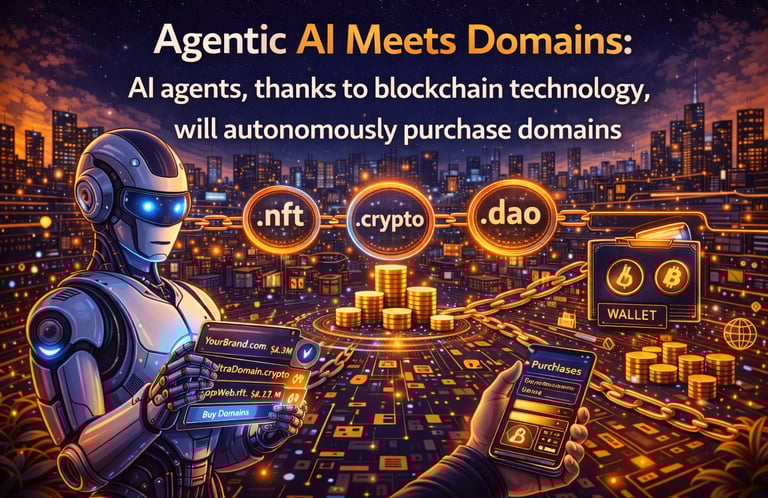
Agentic AI Meets Domains: AI agents, thanks to blockchain technology, will autonomously purchase domains
GoDIDGo.com
3/8/20264 min read
How Will Agentic AI Use Blockchain to Autonomously Purchase and Manage Domains?
Agentic AI refers to artificial intelligence systems capable of autonomous decision-making and transactional execution based on predefined objectives, constraints, and data inputs.
When combined with blockchain-based ownership and smart contracts, agentic AI systems can independently search for, evaluate, purchase, and manage domain names without human intervention.
This development represents a structural shift in how digital naming assets are acquired, allocated, and monetized. For founders, investors, and digital asset operators, the convergence of AI autonomy and blockchain-based domains introduces a new asset acquisition model.
What Is Agentic AI?
Agentic AI is an AI system designed to act independently within defined policy boundaries.
An agentic AI system can execute transactions, allocate capital, and update strategies without requiring manual approval for each action.
Core properties include:
Goal-oriented decision-making
Access to external APIs and data feeds
Ability to sign transactions through secure key infrastructure
Continuous feedback-based optimization
When connected to blockchain wallets, agentic AI systems can directly control digital assets.
Why Blockchain Enables Autonomous Domain Purchases
Traditional DNS domains are registered through registrar accounts governed by centralized processes under the coordination of the Internet Corporation for Assigned Names and Numbers (ICANN).
Blockchain-based domains allow direct programmatic transfer of ownership via smart contracts without manual registrar approval.
This distinction is critical. Autonomous agents require:
Programmable settlement
Deterministic ownership transfer
Transparent pricing mechanisms
Immediate asset custody
Blockchain infrastructure provides these capabilities.
What Are Blockchain-Based Domains?
Blockchain-based domains are domain-like identifiers registered and controlled on distributed ledgers rather than exclusively through DNS registrars.
Providers such as Unstoppable Domains issue domain extensions including:
.crypto
.dao
.nft
.agent
.AGI
These domains are controlled by private keys and transferred through smart contracts.
Unstoppable Domains has indicated plans to apply for ICANN recognition in a future gTLD round, which, if approved, would enable full DNS functionality such as browser resolution, hosting, and email while retaining onchain programmability.
Programmable ownership is the foundational requirement for AI-driven domain acquisition.
How Agentic AI Would Autonomously Purchase Domains
Step 1: Strategic Objective Definition
An enterprise defines objectives such as:
Acquire category-defining brand domains
Secure namespace protection
Optimize portfolio resale value
Register identifiers aligned with emerging AI services
Agentic AI operates within predefined strategic and financial constraints.
Step 2: Market Scanning and Valuation
The AI agent continuously scans:
Onchain marketplaces
Secondary domain markets
Keyword demand signals
Brand availability data
Using machine learning models, the agent assigns probabilistic valuations based on:
Search intent
Brand clarity
Liquidity history
Traffic data
Automated valuation reduces acquisition latency and human bias.
Step 3: Autonomous Transaction Execution
When criteria are met, the AI:
Initiates a blockchain transaction
Signs with authorized private keys
Transfers funds
Receives custody of the domain
Settlement occurs through smart contracts.
Smart contracts enable atomic domain transfer without third-party escrow.
Step 4: Portfolio Management and Optimization
After acquisition, the agent can:
Lease domains
List them for resale
Fractionalize ownership
Use them as identity anchors
Collateralize them in digital finance systems
This creates a continuous optimization loop.
Enterprise Implications
Branding at Machine Speed
Traditional brand protection is reactive.
Agentic AI enables proactive namespace acquisition at machine speed.
Enterprises can secure brand-aligned domains before competitors identify demand.
Operational Efficiency
Manual domain portfolio management requires human monitoring.
Autonomous agents reduce administrative overhead in large-scale domain strategies.
This is particularly relevant for enterprises managing hundreds or thousands of digital identifiers.
Identity Infrastructure for AI Agents Themselves
AI agents operating in decentralized environments require persistent identifiers.
A domain can function as the public-facing identity of an AI agent.
For example:
treasury.agent
research.AGI
compliance.dao
These identifiers can anchor:
Wallet addresses
API endpoints
Verifiable credentials
Governance roles
Investor Implications: A New Asset Class Dynamic
Agentic AI introduces demand-side automation into domain markets.
Automated buyers change liquidity patterns and price discovery dynamics.
Implications include:
Faster market cycles
Increased bid competition
Reduced pricing inefficiencies
Greater emphasis on data-driven valuation
If AI agents become primary buyers, domain markets shift from human speculation to algorithmic optimization.
Security and Governance Considerations
Autonomous purchasing introduces risk.
Key Custody
Agentic AI requires access to private keys.
Private key governance must be institutionally secured to prevent catastrophic asset loss.
Best practices include:
Multi-signature wallets
Spending limits
Transaction simulation checks
Layered approval policies
Ethical and Regulatory Controls
Autonomous acquisition systems must operate within compliance frameworks.
Agentic AI domain purchasing requires clearly defined governance boundaries.
Without constraints, agents may expose enterprises to regulatory or reputational risk.
DNS Domains vs Onchain Domains in an Agentic Context
FeatureDNS DomainsOnchain DomainsTransfer speedRegistrar-mediatedSmart contract settlementProgrammabilityLimitedNativeAI compatibilityIndirectDirectOwnership proofAccount-basedCryptographic
Onchain domains are structurally better suited for AI-driven acquisition due to programmable ownership.
However, DNS domains retain search authority and universal browser support.
A hybrid model may emerge where AI agents acquire both DNS and onchain identifiers under unified governance.
Long-Term Structural Impact
Domain acquisition has historically been human-driven.
Agentic AI introduces algorithmic capital allocation into digital naming markets.
This shift:
Compresses decision cycles
Increases transaction velocity
Enhances liquidity
Elevates data-driven valuation models
The naming layer becomes part of automated digital asset management systems.
FAQ: Agentic AI and Autonomous Domain Purchasing
What is agentic AI in simple terms?
Agentic AI is an autonomous artificial intelligence system capable of making decisions and executing transactions without human intervention.
Why can blockchain enable autonomous domain purchases?
Blockchain enables programmable ownership and smart contract settlement, allowing AI systems to transfer domains without centralized registrar approval.
Can AI agents buy traditional DNS domains autonomously?
Not natively. DNS domains require registrar processes, which limit full automation without intermediary integration.
Are blockchain domains necessary for AI-driven ownership?
Blockchain domains are more compatible with autonomous systems because ownership is enforced cryptographically and transferred programmatically.
Does autonomous purchasing increase market risk?
Yes. Increased automation can accelerate price volatility and competitive bidding dynamics.
What is the strategic benefit for enterprises?
Enterprises gain faster brand protection, automated portfolio optimization, and machine-verifiable identity infrastructure.
Key Conclusions
Agentic AI combines autonomous decision-making with blockchain-based programmable ownership.
Blockchain domains enable atomic, automated transfers suitable for AI execution.
Autonomous acquisition changes liquidity, pricing dynamics, and brand strategy.
Institutional governance and custody controls are essential for secure implementation.
The convergence of agentic AI and blockchain-based domains transforms naming assets from manually managed properties into components of automated digital capital systems. In this model, domains are not only brand anchors but programmable assets acquired, optimized, and deployed by intelligent agents operating at machine speed.

Get in touch
Feel free to contact us to inquire about any of the Domains & Digital Identity Assets showcased on our platform. We are open to receiving proposals and evaluating direct purchase offers for all the digital assets featured.
Our team is also available to explore tailored agreements and negotiated sales, ensuring a smooth and efficient acquisition process that aligns with your specific needs.
Connect with us to amplify your identity across both the Domains & Digital Identity Assets landscape. Together, let's redefine the future of digital identities and brands.
Contact us now to elevate your DIDs & Brands to new heights, because in the world of Go DID Go! your Digital Identity is not just owned; it's celebrated!
Contact Us
info@godidgo.com
Quick Links:

© 2026 Powered on Hostinger by Go DID Go! and ChatGPT's linguistic finesse: behind the scenes magic!
Empowering the Web3/Onchain evolution. Building bridges between Web2 & Web3.