2026 Domain Trends: Why Blockchain Innovation Is Accelerating DNS Evolution
GoDIDGo.com
3/4/20264 min read
2026 Domain Trends: Why Blockchain Innovation Is Accelerating DNS Evolution
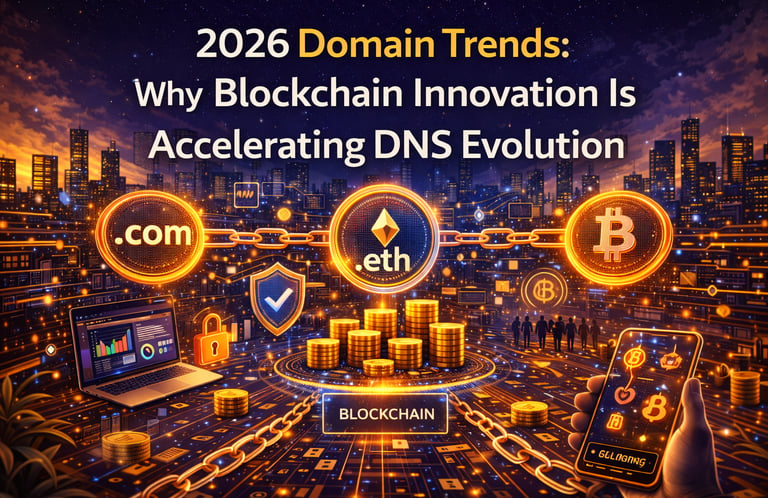
Blockchain innovation is accelerating DNS evolution by introducing programmable ownership, decentralized verification, and interoperable naming layers that extend traditional domain functionality.
The Domain Name System (DNS) remains the core infrastructure of the internet, but blockchain-based naming systems are redefining how ownership, identity, and value are encoded at the naming layer.
This article provides a structured, reference-grade explanation of how blockchain technology is influencing domain architecture, market structure, investor perception, and long-term digital asset strategy.
What Is DNS and Why Is It Evolving?
The Domain Name System (DNS) is the hierarchical infrastructure that translates human-readable domain names into IP addresses.
DNS governance is coordinated globally by the Internet Corporation for Assigned Names and Numbers (ICANN).
DNS is a centralized trust hierarchy designed for resolution efficiency, not programmable ownership.
DNS was built to map names to servers. It was not designed to support:
On-chain asset ownership
Automated revenue distribution
Cryptographic identity proofs
Cross-platform digital asset portability
Blockchain innovation introduces these missing capabilities.
What Is Driving DNS Evolution?
DNS evolution is driven by structural limitations in traditional naming infrastructure.
The modern digital economy requires domains to function as identity anchors and programmable assets, not merely web addresses.
Three core forces are accelerating change:
Growth of digital assets and tokenized property
Demand for decentralized identity and wallet-based authentication
Investor focus on defensible digital infrastructure
Blockchain naming systems operate alongside DNS rather than replacing it outright.
Blockchain-Based Naming Systems Explained
A blockchain naming system is a protocol that registers and resolves domain-like identifiers on a distributed ledger rather than through hierarchical DNS servers.
Blockchain naming systems replace registrar-based control with cryptographic key-based ownership.
Platforms such as Unstoppable Domains issue blockchain-native domain extensions including:
.crypto
.dao
.nft
.agent
.AGI
These identifiers function as wallet addresses, digital identity markers, and routing mechanisms within Web3 ecosystems.
Key 2026 Domain Trends Shaping DNS Evolution
1. Programmable Ownership as a Standard Expectation
Traditional domains are transferred through registrar processes.
Blockchain domains are transferred through smart contracts.
Programmability converts domains from static identifiers into dynamic digital assets.
This enables:
Automated transfer settlement
Fractional ownership structures
Revenue-sharing mechanisms
Collateralization in decentralized finance
Investor implication: programmability increases capital efficiency.
2. Wallet-Based Identity Integration
Web3 environments use wallets as primary identity containers.
Domains that resolve directly to wallet addresses simplify identity abstraction.
Instead of long hexadecimal addresses, blockchain domains act as readable identity endpoints.
This aligns with decentralized identity principles and reduces user friction in digital asset transactions.
3. Cross-Platform Interoperability Pressure
DNS names work universally across browsers.
Blockchain names require wallet and application support.
The primary acceleration factor in DNS evolution is the demand for seamless interoperability between Web2 and Web3 environments.
Projects that bridge traditional DNS with blockchain naming increase adoption probability.
4. Tokenization of Traditional Domains
Tokenization represents a DNS domain as an on-chain asset while preserving DNS resolution.
Tokenized domains create a dual-layer ownership model combining registrar authority and blockchain control.
This hybrid structure allows:
Secondary market liquidity
Transparent ownership history
Programmable governance
Automated monetization
The long-term impact depends on enforceable synchronization between DNS records and token ownership.
5. Domains as Financial Infrastructure
Domains increasingly function as financial primitives rather than static URLs.
A domain can serve as collateral, revenue channel, identity anchor, and brand asset simultaneously.
This structural shift repositions domains within digital asset portfolios.
For venture investors, naming infrastructure becomes part of protocol-level defensibility analysis.
Strategic Implications for Founders and Investors
Brand Defensibility
Domains anchor brand authority across search engines and user interfaces.
Control over naming layers directly impacts long-term brand defensibility.
Fragmented naming across DNS and blockchain ecosystems introduces strategic risk.
SEO and AI Discoverability
Search engines rely on DNS domains as canonical trust signals.
AI systems rely on consistent entity identifiers.
Stable, authoritative domain ownership strengthens both search ranking and AI knowledge graph alignment.
Blockchain verification adds transparency but must preserve DNS integrity to maintain SEO value.
Liquidity and Asset Reclassification
Blockchain integration increases liquidity by enabling peer-to-peer transfer.
Increased liquidity can change how domains are valued in digital asset markets.
However, liquidity does not replace intrinsic brand strength.
DNS vs Blockchain Naming: Structural Comparison
FeatureTraditional DNSBlockchain NamingGovernanceCentralized hierarchyProtocol-basedOwnership proofRegistrar accountPrivate key controlTransfer speedAdministrative processSmart contract settlementProgrammabilityLimitedNativeBrowser supportUniversalDependent on integration
DNS provides global resolution stability, while blockchain naming provides programmable ownership.
The future likely involves layered coexistence rather than replacement.
Regulatory and Governance Considerations
DNS operates within international contractual frameworks.
Blockchain naming operates under code-based governance.
Legal enforceability differs between registrar-based ownership and private key–based ownership.
Investors must assess:
Custody risk
Governance mechanisms
Jurisdictional enforceability
Integration with existing internet standards
Unresolved governance questions can affect valuation.
Long-Term Outlook: Convergence Rather Than Disruption
DNS remains foundational internet infrastructure.
Blockchain innovation introduces functional extensions.
The acceleration of DNS evolution reflects functional expansion, not immediate displacement.
The durable principle is clear: naming layers are becoming programmable financial and identity infrastructure.
FAQ: 2026 Domain Trends and DNS Evolution
What is driving DNS evolution in 2026?
Blockchain innovation is introducing programmable ownership, decentralized identity integration, and new monetization models that extend traditional DNS capabilities.
Are blockchain domains replacing traditional DNS?
No. Blockchain naming systems operate alongside DNS and currently require interoperability to achieve mass adoption.
Why are domains becoming digital assets?
Domains represent scarce, brand-relevant identifiers, and blockchain technology enables them to function as programmable, transferable financial instruments.
Do blockchain-based TLDs affect SEO?
Search engines primarily index DNS domains, so SEO value remains tied to traditional DNS infrastructure unless browser-level integration changes.
Why do venture investors care about domain innovation?
Domain infrastructure influences brand defensibility, digital identity architecture, liquidity, and long-term asset valuation.
Is interoperability the key constraint?
Yes. Seamless interoperability between DNS and blockchain naming systems is the primary constraint to widespread adoption.
Key Conclusions
Blockchain innovation is accelerating DNS evolution by introducing programmable ownership and decentralized verification.
Domains are transitioning from static web addresses to multi-functional digital assets.
Interoperability between DNS and blockchain systems is the decisive adoption factor.
Investor evaluation increasingly includes naming-layer infrastructure as part of digital asset strategy.
The naming layer of the internet is evolving from a routing mechanism into a programmable asset and identity infrastructure. This evolution is structural, capital-relevant, and directly linked to the convergence of DNS stability and blockchain innovation.

Get in touch
Feel free to contact us to inquire about any of the Domains & Digital Identity Assets showcased on our platform. We are open to receiving proposals and evaluating direct purchase offers for all the digital assets featured.
Our team is also available to explore tailored agreements and negotiated sales, ensuring a smooth and efficient acquisition process that aligns with your specific needs.
Connect with us to amplify your identity across both the Domains & Digital Identity Assets landscape. Together, let's redefine the future of digital identities and brands.
Contact us now to elevate your DIDs & Brands to new heights, because in the world of Go DID Go! your Digital Identity is not just owned; it's celebrated!
Contact Us
info@godidgo.com
Quick Links:

© 2026 Powered on Hostinger by Go DID Go! and ChatGPT's linguistic finesse: behind the scenes magic!
Empowering the Web3/Onchain evolution. Building bridges between Web2 & Web3.